Showing posts with label Creating habitat. Show all posts

Thursday, December 17, 2015

Why manicured lawns should become a thing of the past

By Adrian Higgins December 2, 2015
 
 
Many folks, not to mention homeowners associations, cling to that model of the American yard as one of clipped foundation shrubs, groomed lawns and trees with mulch circles. Naked soil must be blanketed spring and fall with shredded mulch. Fallen leaves are treated as trash.
The real gardening world left this fusty model years ago, embracing soft groupings of perennials, grasses and specimen trees and shrubs in a celebration of plants and a closer communion with nature.
Thomas Rainer and Claudia West are two young plant designers — he’s 39, she’s 32 — who cut their teeth on this aesthetic and are among a new wave of influential practitioners who are pushing this naturalism to the next level.
They reject the popular approach of using indigenous plants exclusively to redeem a wilderness because such a place no longer exists: We’ve spent four centuries on this continent erasing it. Instead, we can bring a natural idiom to all the green places that we live with. Because more than 80 percent of the U.S. population lives in urban areas, that means rooftops, city gardens, old suburban yards, parking lots, utility easements, highway medians and the rest.
If we accept that nature as we imagined it resides in the past, they argue, we are free to turn all these immediate spaces, including our gardens, into naturalistic landscapes that will be more satisfying and less work than the lawn and manicured-shrubbery approach.
This premise is not entirely new: A generation ago, top designers were espousing “the New American Garden” with many of the same principles, of replacing lawns and shrubbery with perennials and ornamental grasses.
What has changed at the vanguard of garden design? Many more varieties of perennials are widely available now than in the 1990s and, moreover, the approach to planting design is changing fundamentally.
Rainer, West and others are promoting a shift from clumping and grouping plant varieties to mixing them in a way that occurs in nature. Discrete clumps are replaced with interplanted varieties equipped by nature to live cheek by jowl.
“The key is to pay attention to how plants fit together,” Rainer said. “To pay attention to their shape and behavior.” This involves not only their growth patterns aboveground, but their root types, which permit plants that are surface-rooted, such as many ground covers, to coexist with deep-rooted meadow flowers and grasses.
Such landscapes can look unexpectedly decorative in fall and winter, as the grasses become burnished by the cold and the remnant stalks and seed heads of perennials capture frost and snow.

The design concept allows plant layering that carries ornament beyond the growing season. (Mark Baldwin/Timber Press)
Significantly, the designers reject the broadly held notion that naturalistic planting has to be of native plants, arguing that a plant’s performance and adaptability are more important than its lineage. “The question is not what grew there in the past but what will grow there in the future,” Rainer and West write in their new book, “Planting in a Post-Wild World.” Aimed at design professionals — though of appeal to anyone who loves the process of gardening — the book is both a design manual and a manifesto.
They see the garden as no longer a collection of plants but rather a designed plant community. This is distilled into three layers. In a sunny, meadow-like garden, the uppermost layer takes the form of beefier structural perennials such as Joe-Pye weed, cup plant or Indian grass. The middle layer is the showiest and provides seasonal peaks with such things as daisies, daylilies, butterfly weeds or bee balms.
The most important layer, the ground cover, is the least showy. Forget tired spreads of English ivy or pachysandra; Rainer and West are thinking of sedges, small grasses, rushes. In shade gardens, the floor layer would consist of such woodland beauties as foamflower, trilliums, gingers and Allegheny spurge.
“The approach to ground cover is, for us, the single most important concept of creating a functioning plant community,” they write. “Think about seeing plants in the wild; there is almost never bare soil.”
The ground cover not only knits together the whole plant community physically and emotionally, but also performs an important horticultural function. Soil left bare will invite weeds, so we smother it in mulch, which has its value, but we keep piling it on for aesthetic rather than horticultural reasons. This is inherently unsustainable and expensive, and keeps lonely plantings in a perpetual state of establishment.
Rainer, who lives in Arlington, is a landscape architect at Rhodeside & Harwell in Alexandria. West is a horticulturist and designer with North Creek Nurseries in Landenberg, Pa. Both are popular speakers at symposiums and conventions across the country, where they reach leading landscape designers and horticulturists receptive to this ecological approach.
“It’s going to be the future of landscape design,” said W. Gary Smith, a Toronto- and New York-based landscape architect and a member of the American Society of Landscape Architects’ education advisory committee. “What these guys are doing is showing how to plant landscapes from the soil up. It’s not just about plant combinations, textures, colors; it’s about looking at plant communities in the wild as an inspiration for design. It’s a hybrid of horticulture and ecology, and it’s been a long time coming.”
“It’s a great concept to be presenting, and hopefully landscape architects and designers will move forward with this,” said Adam Woodruff, a garden designer from Clayton, Mo., who has embraced this approach with elan. “It’s not a style for everyone and it’s not something everyone can do; you have to have an understanding of the plants you’re working with for it to be effective.”

A stylized dry meadow garden designed by Adam Woodruff. (Adam Woodruff/Timber Press)
This form of gardening is very exciting, promising to introduce many more underused plants into our gardens and, moreover, to create herbaceously dominant landscapes that are dynamic, ecologically kind and most of all, profoundly beautiful when executed with skill. The potential for it to go wrong is pretty great, though, especially if it is done on a half-baked basis. It takes fortitude and a large budget to plant perennials and ground covers by the hundreds, and I can envision stabs at this that are too timid. One hopes that retail nurseries will make affordable plug plants available to consumers who are willing to maintain a young garden and wait for it to fill in.
The concept faces other obstacles. How do you get people who aren’t gardeners to understand that an assembly of hairy plants is not a weed patch? Rainer told me that it is incumbent on designers to create gardens that can be read as such — by adding more floriferous varieties to the mix, by selecting lower-growing varieties and by setting these plant communities in strong architectural frames with clear edges. “It puts the burden on designers to design in a way that it doesn’t look wild,” he said. “The best design interprets nature; it doesn’t imitate it.”

The rooftop garden at the David Lawrence Convention Center in Pittsburgh. The massed planting of sedum and the path temper the wildness of the mixed meadow planting. (Sarah Thompson/Timber Press)
What about landscape crews programmed to mow, blow, chop back dead top growth and apply pesticides and fertilizers on a schedule rather than nurture a naturalistic design through its establishment stages and through four seasons? “I feel strongly that these mixes can be much lower maintenance,” he said. In the book, he and West talk about a move away from landscape maintenance to a lower pitch of management.
“This is a system based on knowledge rather than labor, and that’s self-limiting in its own way,” he said. “But we feel there is a paradigm shift in how plants are read, and as that knowledge catches up, there can be great benefits to landscape crews and home gardeners alike.”


Thursday, July 24, 2014

Replanting for Madagascar’s Future

How people and wildlife will benefit, and some of the world's great forests maintained for future generations.
 
Lemurs are little mammals found only in the forests of the island nation of Madagascar – and they are incredibly easy to love! What is less obvious is their close relationship with the future of trees in a land where, sadly, forests have often been leveled for short-term, gains. The lemurs are the victims. So are Madagascars impoverished citizens.
 
Black and White Ruffed lemurs provide an ecological service by aiding fruit seed germination through digestion of seed coatings. Photo by Dr. Edward Louis
 
Dr. Edward E. Louis Jr. of the Omaha Henry Doorly Zoo and Aquarium explains that 90 percent of a lemur's diet is fruit. Because of their enormous appetites, lemurs eat frequently and process their meals rapidly. Amazingly, this leaves behind seeds that have had their coatings removed through partial digestion but are otherwise intact. Dr. Louis has found that this produces seeds with a germination rate of nearly 100 percent, compared to only 5 percent of unprocessed seeds.
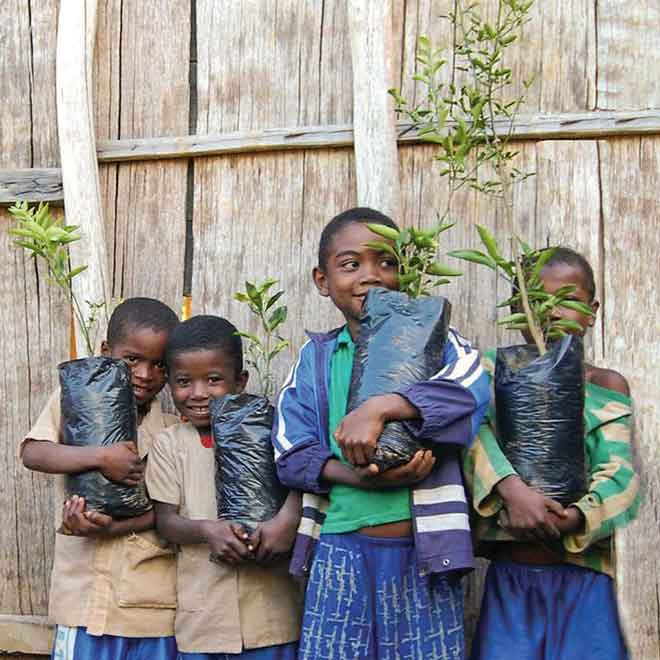
Thanks to the generosity of Arbor Day Foundation members, Rain Forest Rescue donations are being used to help residents and students collect these seeds for planting in nurseries that are being built in critical locations. It is all part of a plan devised by Dr. Louis and his colleagues to help restore the forests of Madagascar, provide habitat to save the endangered lemurs, and improve the economy and living conditions of local people.
We are creating a program that is sustainable, says Dr. Louis, head of the Madagascar Biodiversity Partnership (MBP). It is providing jobs today and for the childrens' future. It will also help Madagascar be less dependent on other countries, he says.
 
Area schools work with the Madagascar Biodiversity Partnership to teach children about conservation.
 
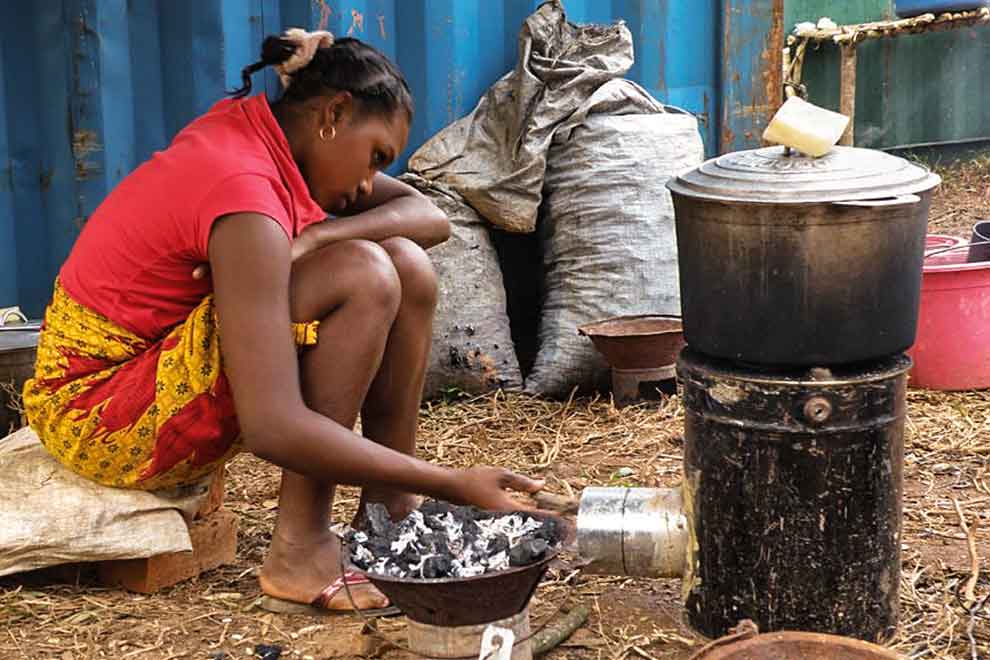
The low-cost, high-germination seeds are keys to the plan. So is what Dr. Louis calls the country's greenhouse-like climate. By building nurseries, people are employed and seedlings can be ready for planting quickly and economically. Through reforestation, erodible, denuded soil can be stabilized thanks to the growth rates of planted trees that sometimes measure ten linear feet a year or more. To encourage residents to engage in this better approach to their natural resources, incentives in the form of conservation credits are offered. These can then be exchanged for life-changing items such as fuel- saving Rocket Stoves and Tough Stuff Solar Kits.
Areas to be planted are prioritized to provide corridors between existing blocks of remaining forests. This is to allow movement of animals and assure genetic interchange that is essential to providing healthy populations and ending the sad history of extinctions that has plagued the country. Another strategy is to stratify the planting areas. Dr. Louis explains that typically the top 50 percent of a mountain will be zoned for permanent trees. These help serve as a water reservoir to feed the streams that are vital to the nation's rice fields. The next lower 35 percent of the mountain is planted with desirable timber species and managed for sustainable forestry. Rosewood, ebony and other valuable hardwoods are planted here for later selective harvest. Prompt replanting is part of the system to assure the continuous availability of forest crops without destroying wildlife habitat. The lower 15 percent is then devoted to fruit trees. Mangos, bananas, the popular litchi and others are planted for consumption or sale, as well as for sharing with lemurs.
 
Fuel-saving Rocket Stoves are one of the items provided to residents through the exchange of conservation credits.
 
While there is no simple solution to poverty and habitat destruction in Madagascar, the Biodiversity Partnership's innovative plan offers a practical way to encourage communities to sustain themselves through the conservation of resources rather than resorting to short-term exploitation. Rain Forest Rescue is a supporting partner in this promising endeavor. Through member donations, Madagascar's people and wildlife will benefit, ecotourism can be attracted, and some of the world's great forests will be maintained for future generations.
 
One way you can help save Rain Forests is through the National Arbor Day Foundation's Rain Forest Rescue Program.


Wednesday, July 23, 2014

Wildlife Wednesday -- Threatened Gopher Tortoises Benefit from Florida Community Wildlife Habitat

I know this is a City of Fort Lauderdale site but I would like to give a shout-out to our neighbors in Oakland Park and my friend, Charlie Livio.  Way to go!  Fort Lauderdale is also in the process of becoming a   Community Wildlife Habitat™.   – Gene
 
0 7/22/2014 // By Patrick Fitzgerald
 
Our amazing Garden for Wildlife volunteers in Oakland Park, FL are making a difference for the threatened gopher tortoise. The city, which is located in Broward County and is smack dab in the middle of the Miami metropolitan area, is working to become certified by National Wildlife Federation as a Community Wildlife Habitat™. So far, the core team of volunteer leaders has activated the citizens of Oakland Park to:
  • Create and certify more than 150 wildlife habitats and gardens at schools, homes and businesses;
  • Educate community members, especially children and youth, through National Wildlife Federation’s Schoolyard Habitats program; and
  • Engage in volunteer restoration projects to better understand why wildlife, nature and the environment are important for our health and well-being.
As part of this effort, something special is also happening for tortoises.
 
Oakland Park Making Room for Gopher Tortoises
 
Charlie Livio, the NWF Community Wildlife Habitat Team Leader for the city, pitched an idea to the City Council that Oakland Park should become the first site to participate in Florida’s Waif Tortoise Adoption Program. (A “waif” gopher tortoise is one that has been removed from the wild.)
The City Council approved of the idea, and in 2011, they adopted four gopher tortoises located at the Lakeside Sand Pine Preserve (including this one, pictured here snacking on fruits and veggies):
 
 
Gopher tortoises are a keystone species that have roamed planet Earth for somewhere between 500,000 and 2 million years. However, due to habitat loss and other threats, they are listed as a federally threatened species in Louisiana, Mississippi and part of Alabama. The State of Florida considers them threatened as well.
Creating Habitat at Lakeside Sand Pine Preserve
Charlie (who also happens to be the city horticulturist and vice president of the city’s Garden Club) knew the Lakeside Sand Pine Preserve was great potential habitat for gopher tortoises. The 5.6-acre remnant sand pine scrub has high, rapidly draining and acidic sands, and is home to more than 75 plant species, including the American Beautyberry, pictured here:
 
 
However, due to a lack of natural wildfires and other processes, the preserve is at risk of going through “succession” and becoming a scrub oak hammock. To keep the sand pine scrub in a healthy state for its unique flora and fauna, staff at the preserve organize an annual volunteer habitat restoration and cleanup.


Adding to the Family
After their work improving the habitat in the preserve, the city was approved to adopt two male gopher tortoises in September of 2013. Just a few months later in December, a hatching was reported and seen at the preserve.
 
 
Last week, Charlie let us know that he saw a potential new juvenile gopher tortoise burrow (pictured below) on the Lakeside Sand Pine Preserve property—evidence that the tortoises are successfully breeding at the site!
 
 
We’re very excited to hear further updates from Charlie and the City of Oakland Park’s Community Wildlife Habitat team. Their work in the Lakeside Sand Pine Preserve and throughout the city has them well on their way to achieving certified Community Wildlife Habitat status.
 
Is Your Community Certified?
National Wildlife Federation has certified 75 Community Wildlife Habitat sites, and is helping more than 100 other registered sites achieve their certification. What communities are certified in your state?