Showing posts with label Reforestation. Show all posts

Thursday, February 12, 2015

Finding the right tree for your space

Planting a tree can be fun and rewarding but you need to make sure you plant the right tree in the right place so that 10 to 15 years down the road the tree is not causing damage.  We are very lucky in South Florida that we have a wide range of tree species that grow in a multitude of sizes.  You should be able to find at least one tree species that will fit the space that you have.  Watch this blog over the next year for information on selecting the right tree for your planting space.  Here’s some basic information to consider when selecting a tree.  -- Gene
 
 
Growing space both above and below ground should be considered when selecting a tree to plant. Too often allowances are not made for the increased size of the tree when it matures. Some of the problems that can be avoided by selecting the proper tree for the available planting space are:
 
•Damage to houses through cracked foundations, leaves in gutters or abrasion of tree limbs hitting the house;
•Cracked pavement of sidewalks, driveways, porches and patios;
•Sewer lines or septic tanks clogged by roots;
•Dangerous screening by obscuring traffic signs, pedestrians or vehicles;
•Storm damage and electrical problems from trees or limbs affecting utility lines; and
•Blocking scenic views or windows.
 
One objective for planting trees in a residential setting is to provide shade to cool homes during the summer months. For morning shade, plant trees on the southeast exposure of the house. For afternoon shade, trees should be planted on the southwest exposure. Deciduous trees (those that lose leaves during the winter) allow the sun to warm the house during winter and shade it during the summer months. Evergreen trees planted on a northern exposure will screen or block cold winter winds.
 
Remember that trees will become larger with age. Your evaluation of the site before planting will allow you to choose the correct size of tree for the site, avoid crowding before it occurs and save time and money at some future date.


Thursday, October 2, 2014

From Exotic Garden to Eco-Haven (Science Friday Podcast)

I listened to this Science Friday podcast last week and it explained very well why I do the exotic plant removal projects I do.  Hopefully I’ll see as much success in mine as they seem to be having!  --Gene
 
Duke Farms has transformed expanses of mown lawn to meadow habitats, teeming with biodiversity.
Photo courtesy of Duke Farms
 
 
In 1893, tobacco millionaire James Buchanan Duke began work on an estate in central New Jersey. Duke wanted things just so. Hundreds of workers built hills where there used to be flat land. He made lakes. He imported thousands of trees. He planted exotic plants from around the world.
 
“Visually you would have seen a very pretty manicured park. Lots of lawns,” says Thom Almendinger, head ecologist at Duke Farms. “Greenery isn’t necessarily all good. Just because it's green doesn't mean it’s beneficial for wildlife.”
 
J.B. Duke created a garden that was the envy of his fellow millionaires. Now, Almendinger’s changing it. There’s a park and environmental training ground managed by the Doris Duke Charitable Foundation on the old estate. Almendinger’s trying to make the place more natural, more sustainable—a place where wildlife can live.
 
“The forest patches were degraded, but you wouldn’t have noticed it because they were full of exotic shrubs from other counties that were not beneficial to wildlife,” Almendinger says.
 
We hop into an electric golf cart and head to a spot they call “The Old Foundation,” a place where J.B. Duke started to build a four-story French chateau—then stopped. Trees are growing through the bottom of the three-story-deep foundation. Almendinger says that vultures nest inside. He points from the topmost plaza down to the great lawn. Think Downton Abbey or Versailles—but with meadows at the bottom.
 
“These whole elaborate terraced lawns out in front of the 15-acre great lawn, and these balustrades and fountains and stairways,” says Almendinger. “That 15-acre meadow, that used to be a pure lawn. It was like one of the Frisbee lawns in Central Park.”
 
After J.B. Duke’s death, the property went to his daughter, Doris. People called her the richest girl in the world. She lived on the estate until her death in 1993. A staff of over 200 helped run the grounds. Doris Duke maintained the gardens, including greenhouses filled with tropical orchids and other exotic plants. But after she died, her will didn’t focus on orchids or greenhouses. It said that the property should be used "to protect endangered species of all kinds...and for agricultural and horticultural purposes, including research."
 
Almendinger says that when the decision to try to make the park more sustainable was made, the estate didn’t really fit with the spirit of the will. It looked nice, but had hundreds of hungry deer, disturbed soil, and exotic, invasive species.
 
Today, Nora Wagner is the head of public programs at Duke Farms. She says that the decision to shift the focus of the property to sustainability and environmental education was a relatively simple one.
 
“The thought was 'How do we use this property best, for the preservation of flora and fauna and communicate that to the largest number of people possible in a way that doesn’t harm our land,'” Wagner says.
 
Today the staff are working to control the deer. They’ve yanked out exotic species. The greenhouses grow native plants. There are still orchids here, but they’re mostly ones that naturally grow in the eastern U.S. And the main greenhouse, called the Orchid Range, is the first LEED-platinum certified conservatory in the country.
 
“It’s funny: It’s a conservatory, so a contrived environment, but it’s actually as green as you can get," says Wagner.
 
Passive solar heating, soil heaters, water efficient misters, and rain cisterns all give the place an environmental boost. And more people are visiting now than when it was just an orchid showplace. There’s even a Twitter feed just to give status updates on the parking lots.
 
“Now our visitation since May 2012 is almost a million,” says Wagner. “We're reaching more people and making more of an impact. So I think it was kind of a no-brainer.”
 
Almendinger pays attention to every detail of the park’s natural processes: plants, soil, waste—everything that comes into or out of the park ecosystem. Today, it’s the algae.
 
“Our lakes are very shallow. They get very warm, and there’s a lot of nutrients in them so they call them ‘productive’—a nice way of saying 'hard to manage,'” Almendinger laughs.
 
But they need to be managed—too much algae would choke all the oxygen from the lake. Other places use chemicals to control algae, but Almendinger works to minimize chemicals used on the property. So to help control the algae, they use naturally occurring bacteria combined with harvesting, pulling up the algae with a big machine.
 
A crew is out on the lake with an amphibious vehicle. It looks like an army tank got mixed up with a paddleboat, and then stuck a rake on its front end. It slowly plows through the water lifting out goopy strands of algae. Once the algae dries a bit, it’s composted and used as fertilizer elsewhere on the grounds. Maybe in the greenhouses, or in the community garden plots. Almendinger says the lakes are all growing closer to being a natural habitat—they host otters, mink, and other species.
 
How do they know if their efforts are working? Part of what Almendinger’s looking for are plants and animals you might find elsewhere; everyday species that weren’t here before because the land was so unnatural.
 
“Now as you drive around there's things like rufous-sided towhees, common yellowthroats, brown thrashers,” says Almendinger. “It's taken almost a decade, having rabbits on the property. There was no cover before. Now we see rabbits, chipmunks, normal species in eastern forests. There are a lot of unique changes that are happening. It took a while. There was a lag period where I wasn't sure that what we were doing was working. Within the last two or three years, it's become over abundantly evident that it’s progressively getting better. When I look at old pictures, that's when I get that ‘a ha!’ moment. Not like the anticipation and waiting; it's already happened. It’s maintaining what’s happened and moving it forward that’s our next goal.”
 
Other goals for the future include improving the Raritan river floodplain right outside the central park area. They also want to do more work on agro-ecology, putting the “farms” back in Duke Farms. But Almendinger says that as with all restoration projects, some of the results might not be seen until his children or grandchildren.
 
“One of the things I hope people take away is just an appreciation,” he says. “Unless you appreciate something, you’re not going to want to protect it. People reconnecting and valuing nature. Even on a base level, doesn’t have to be ‘rip out all your exotic plants.’ Understating those qualities that make life wonderful.”
Produced by Charles Bergquist, Director and Contributing Producer


Monday, August 11, 2014

To fight unemployment, India to plant 2 billion trees

Maybe we could/should do something like this in the U.S.!
 
A new initiative in India will employ up to 300,000 youths in an effort to improve air quality and provide opportunities to the unemployed.
Mon, Jul 21, 2014
 
What better way to clean the air along India's roadways than with trees? (Photo: seeveeaar/flickr)
 
Jadav "Molai" Payeng, the Indian man who single-handedly planted up 1,360 acres of forest, may soon have some competition on his hands. Or allies, depending on which way you want to look at it. Huffington Post reports that a new afforestation initiative from India's Rural Development Ministry aims to plant 2 billion trees along the nation's 62,137 miles of highways. The idea, says the article, is to both combat rural poverty and youth unemployment while also improving the environment and helping to clean up India's chronic air pollution:
 
“The country's Rural Development Ministry on Friday announced a new afforestation plan to plant 2 billion trees along the nation’s highways in an effort to tackle youth unemployment. The country’s Road Transport, Highways, Shipping and Rural Development Minister Nitin Jairam Gadkari said in a meeting in New Delhi that the new initiative would also help preserve the environment.
This plan cannot come soon enough. Not only does India have a youth unemployment rate of 10.2 percent, according to the World Health Organization, it is also home to six of the world's 10 cities with the worst air pollution. Given the deadly impact of air pollution worldwide, and the incredible power of trees to absorb emissions, this plan may have a significant impact not just on the economy and biodiversity, but on health as well.” 
 
The plan could potentially employ 300,000 youths, Indian outlet NDTV reports.  This isn't the only recent sign of environmental progress in India either. The country's new prime minister, Narendra Modi, has also announced a target of getting electricity to every home in India by 2019, relying largely on solar power to do so. According to The Hindu, the government is also working on plans to clean up the Ganga and Yamuna rivers. 


Friday, August 8, 2014

Seattle's First Urban Food Forest Will Be Open To Foragers

 
Below is an article about Seattle’s first urban food forest that was written over 2 years ago.  In checking their website – Beacon Food Forest – it appears Phase 1, a 2 acre site, will open on September 13, 2014.  I know these community projects take a long time and a lot of hard work to come to fruition.  Hopefully we’ll start seeing more of these pop up in other urban areas.  Happy Friday!  -Gene
 
From the Beacon Food Forest website -   “The goal of the Beacon Food Forest is to design, plant and grow an edible urban forest garden that inspires our community to gather together, grow our own food and rehabilitate our local ecosystem.”  “A food forest is a gardening technique or land management system, which mimics a woodland ecosystem by substituting edible trees, shrubs, perennials and annuals. Fruit and nut trees make up the upper level, while berry shrubs, edible perennials and annuals make up the lower levels. The Beacon Food Forest will combine aspects of native habitat rehabilitation with edible forest gardening.”
 
 
by Kristofor Husted
March 01, 2012
 
 
If you're a regular reader of The Salt, you've probably noticed our interest in foraging. From San Francisco to Maryland, we've met wild food experts, nature guides and chefs passionate about picking foods growing in their backyards.
Now, Washington state has jumped on the foraging bandwagon with plans to develop a 7-acre public plot into a food forest. The kicker? The lot sits smack in the middle of Seattle.
The idea is to give members of the working-class neighborhood of Beacon Hill the chance to pick plants scattered throughout the park – dubbed the Beacon Food Forest. It will feature fruit-bearing perennials — apples, pears, plums, grapes, blueberries, raspberries and more.
Herlihy and a team first assembled their vision of a food forest in 2009 as a final project for a permaculture design class.
 
If all goes well in the food forest's 2-acre trial plot, the whole 7-acre park will look something like this
 
After some community outreach, local support came pouring in for the idea. Herlihy and the Friends of Beacon Food Forest community group received a $22,000 grant to hire a certified designer for the project.
A local utility, Seattle Public Utilities, offered up the 7-acre plot, which could make it the largest, urban food forest on public land in the U.S., Glenn Herlihy, a steering committee member for the project, tells The Salt.
The group is currently working with $100,000 in seed money to set up the first phase: a 1.75-acre test zone to be planted by the end of the year. After a few years, if that section is deemed successful by the city, the remaining acreage will be converted to food trees.
Of course, any "free" food source begs the question of what to do with overzealous pickers. No definitive answer on how to handle that predicament has been established yet, though. According to Herlihy, the only solutions right now are to produce an abundance of fruit so there's enough for everyone and to embed "thieves' gardens" with extra plants in the park for those people eager to take more than their share.
For now, getting the park on its feet and drawing neighbors to its bushy terrain ranks highest on the totem pole of goals, Herlihy says. He hopes that the park will become a congregating area for the diverse residents of the neighborhood. "There's Vietnamese, Chinese, Filipinos, and Africans in the area. The Beacon Food Forest is a place where all ages and ethnicities can meet."
Eventually, garden plots in the forest will be available to lease to gardeners for $10 a year. Also, Herlihy says they hope to educate community members on the benefits of permaculture.
"It's a food system being developed in a neighborhood that's looking for more self-reliance," he says. "It's getting people together by having a common denominator: soil."


Thursday, July 24, 2014

Replanting for Madagascar’s Future

How people and wildlife will benefit, and some of the world's great forests maintained for future generations.
 
Lemurs are little mammals found only in the forests of the island nation of Madagascar – and they are incredibly easy to love! What is less obvious is their close relationship with the future of trees in a land where, sadly, forests have often been leveled for short-term, gains. The lemurs are the victims. So are Madagascars impoverished citizens.
 
Black and White Ruffed lemurs provide an ecological service by aiding fruit seed germination through digestion of seed coatings. Photo by Dr. Edward Louis
 
Dr. Edward E. Louis Jr. of the Omaha Henry Doorly Zoo and Aquarium explains that 90 percent of a lemur's diet is fruit. Because of their enormous appetites, lemurs eat frequently and process their meals rapidly. Amazingly, this leaves behind seeds that have had their coatings removed through partial digestion but are otherwise intact. Dr. Louis has found that this produces seeds with a germination rate of nearly 100 percent, compared to only 5 percent of unprocessed seeds.
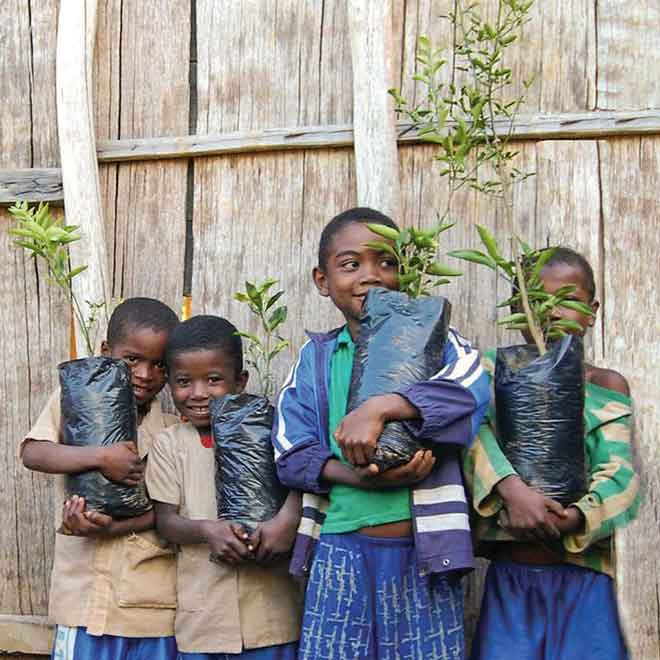
Thanks to the generosity of Arbor Day Foundation members, Rain Forest Rescue donations are being used to help residents and students collect these seeds for planting in nurseries that are being built in critical locations. It is all part of a plan devised by Dr. Louis and his colleagues to help restore the forests of Madagascar, provide habitat to save the endangered lemurs, and improve the economy and living conditions of local people.
We are creating a program that is sustainable, says Dr. Louis, head of the Madagascar Biodiversity Partnership (MBP). It is providing jobs today and for the childrens' future. It will also help Madagascar be less dependent on other countries, he says.
 
Area schools work with the Madagascar Biodiversity Partnership to teach children about conservation.
 
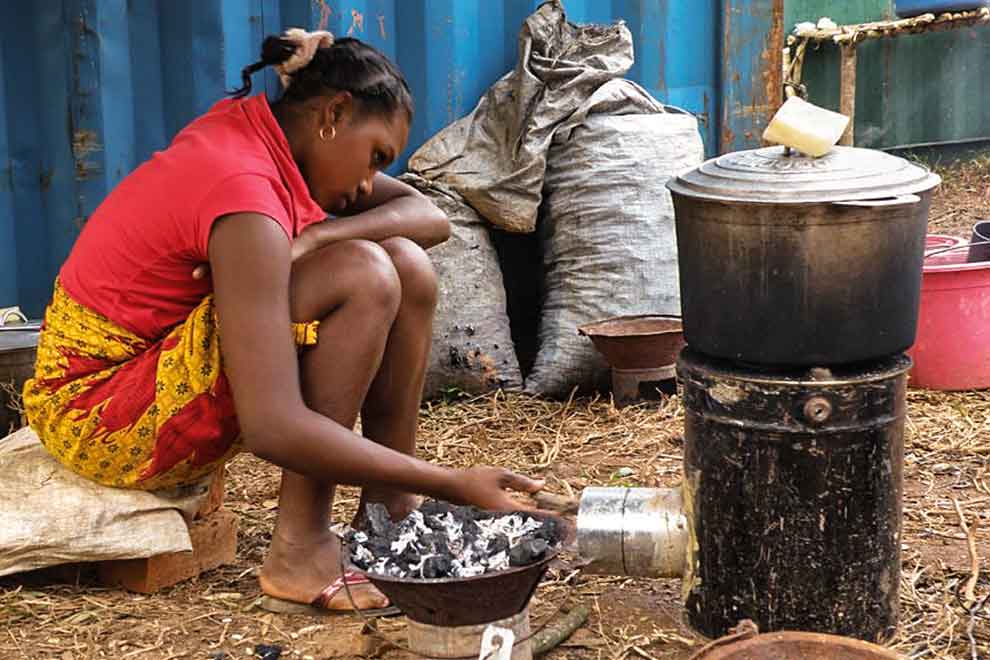
The low-cost, high-germination seeds are keys to the plan. So is what Dr. Louis calls the country's greenhouse-like climate. By building nurseries, people are employed and seedlings can be ready for planting quickly and economically. Through reforestation, erodible, denuded soil can be stabilized thanks to the growth rates of planted trees that sometimes measure ten linear feet a year or more. To encourage residents to engage in this better approach to their natural resources, incentives in the form of conservation credits are offered. These can then be exchanged for life-changing items such as fuel- saving Rocket Stoves and Tough Stuff Solar Kits.
Areas to be planted are prioritized to provide corridors between existing blocks of remaining forests. This is to allow movement of animals and assure genetic interchange that is essential to providing healthy populations and ending the sad history of extinctions that has plagued the country. Another strategy is to stratify the planting areas. Dr. Louis explains that typically the top 50 percent of a mountain will be zoned for permanent trees. These help serve as a water reservoir to feed the streams that are vital to the nation's rice fields. The next lower 35 percent of the mountain is planted with desirable timber species and managed for sustainable forestry. Rosewood, ebony and other valuable hardwoods are planted here for later selective harvest. Prompt replanting is part of the system to assure the continuous availability of forest crops without destroying wildlife habitat. The lower 15 percent is then devoted to fruit trees. Mangos, bananas, the popular litchi and others are planted for consumption or sale, as well as for sharing with lemurs.
 
Fuel-saving Rocket Stoves are one of the items provided to residents through the exchange of conservation credits.
 
While there is no simple solution to poverty and habitat destruction in Madagascar, the Biodiversity Partnership's innovative plan offers a practical way to encourage communities to sustain themselves through the conservation of resources rather than resorting to short-term exploitation. Rain Forest Rescue is a supporting partner in this promising endeavor. Through member donations, Madagascar's people and wildlife will benefit, ecotourism can be attracted, and some of the world's great forests will be maintained for future generations.
 
One way you can help save Rain Forests is through the National Arbor Day Foundation's Rain Forest Rescue Program.


Wednesday, April 2, 2014

Highway Landscaping May Have Squelched Your Road Rage


 There’s a good chance you’ve seen the work of Elisabeth Hassett and an equally good chance you didn’t really notice it. Hassett is the landscape architect for the Florida Department of Transportation’s District 4, which includes Broward and Palm Beach Counties. When there’s a need for highway-side landscape design, Hassett has almost definitely had a hand in choosing the plants and the layout -- a far more complicated art than you might imagine.
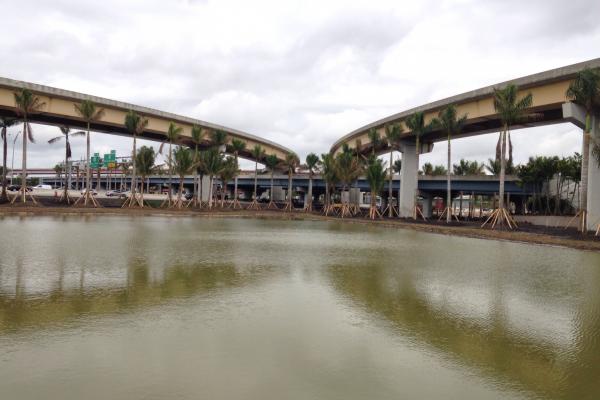
I met Hassett beneath the I-95/I-595 interchange where one of the state’s largest highway beautification projects is finishing up.
MALONE: We’re looking at a $6-million project that includes $2 million worth of trees and plants. Can you describe what $2 million worth of trees and plants even looks like?
HASSETT: Well, the whole theme was to be tropical modern: royal poinsettias (Poincianas), yellow tabebuias, pink tabebuias. The different thing that we did here is we put in these terracing areas. And that allows us to put very large palms in a steep slope. And once it gets filled out it’s going to be really, really beautiful.
MALONE: You might wander on here and mistake it for a golf course if you didn’t know better.
HASSETT: Yeah, but we don’t want anybody to get out of their car and wander here. That isn’t what it’s for; it’s just to drive by and be beautiful and maybe it’ll reduce road rage a little bit because it’s so beautiful. You want to look at the beauty, you don’t want to be looking at the crazy drivers that make you mad.
MALONE: Is this something that we know -- that has been studied -- that road rage, in fact, is affected by the landscaping on our highways?
HASSETT: Absolutely, yes. The shade, the coolness, the beauty all affects drivers for the better.
(I asked Hassett to show us some specific examples of the project’s plant life. She walked me up to a picturesque palm tree.)
This is a coconut palm, it’s very good in hurricanes -- they’re just going to sway. They’re not going to be damaged at all and hardly lose their fronds at all like... the royal palms. The only thing that we will be careful about is as soon as they fruit, we’ll take the fruit down so they don’t become wind obstacles during a storm, because all of our state roads are evacuation routes and we cannot allow them to be blocked in anyway. A lot of the flowering trees are very brittle and break up in the storms. So the golden shower tree, jacaranda -- there’s lots of pretty flowering trees that I won’t allow on the right of way. So these are very, very stable palms and trees that we have.
MALONE: When we talk about $2 million worth of plants and trees, by law the state of Florida has to set aside at least 1.5 percent of the annual construction budget for highway beautification projects. So theoretically the millions of dollars behind this project weren’t going to be used for anything else. But I do think people wonder: Why do we need this at all? Why do we gussy up the interchange to begin with?
HASSETT: Well, business development. Business owners are looking at this, they see a beautiful interchange -- well designed, well taken care of -- they’re going to think, “you know what? I think I want my business in this area.” I’m always watching our state highways for something I can improve or if I see something dying I make sure it’s taken care of, but I’m always looking. I’ve driven this interchange for years and looked over and there was nothing here but wasteland and I would just envision what it could look like. And now it’s here. So it’s really pretty exciting that the vision has come to pass.
 
You can listen to the story and view more photos at the link below:


Friday, March 21, 2014

International Day of Forests

International Day of Forests
21 Mar 2014
21 March every year. Celebrating all types of forest worldwide.
In November 2012 the United Nations General Assembly proclaimed 21 March the International Day of Forests. The aim of the Day is to celebrate all types of forest and raise awareness of sustainable management, conservation and sustainable development for the benefit of current and future generations.
Further information is available on the FAO's International Day of Forests web pages, including some Key Messages about forests.
Did you know...?
·          Forests cover 31% of the world's total land area.
<     Primary (or 'old growth') forests account for 36% of forest area.
<     The livelihoods of over 1.6 billion people depend on forests.
<     Forests are home to 80% of our terrestrial (ie: non-marine)  biodiversity.
<     Trade in forest products was estimated at $327 billion in 2004.
<     Forests are home to 300 million people around the world.
<     30% of forests are used for the production of wood and non-wood products.
      This short film about forests could be used in class to prompt discussion about forests. It has been produced by Yann Arthus-Bertrand, the photographer behind the 'Earth From the Air' photos.


Thursday, January 16, 2014

Tree Islands more effective way to replant the world's forest

By: Liz Kimbrough
January 09, 2014

Worldwide, large swaths of land lay barren in the wake of agricultural expansion, and as global forest cover continues to decline, carbon and water cycles, biodiversity, and human health are impacted. But efforts to restore abandoned pastures and agricultural plots back into functioning forest ecosystems are often hindered by high costs and time requirements. Fortunately, scientists have developed a new method for a more cost effective solution to forest restoration, the establishment of "tree islands."
Figure 1 Forest eight years after replanting.  Photo courtesy of Karen Holl

Typically, forest restoration involves planting rows of trees, plantation style, which cover the entire restoration site. However, a team of researchers led by Rakan A. Zahawi of Las Cruces Biological Station in Costa Rica and Karen Holl of UC Santa Cruz recently tested an innovative method known as applied nucleation or the "tree island method" to facilitate forest recovery. In the tree island method, clusters of trees are spread out across the site instead of covering the whole deforested area. For this study, the researchers tested three different treatments on abandoned pasture plots in Costa Rica: planting tree islands, plantation style planting, and no planting or what is known as "passive restoration."

"We were surprised," Karen Holl told mongabay.com, "that the applied nucleation strategy was as effective in facilitating the natural establishment of forest tree seedlings as planting the entire area with trees, even though we only planted 27% of the trees in the applied nucleation treatment."

The establishment of tree islands, around the size of 100m2, serves as an "activation energy" of sorts. As the trees grow, they shade out competitive pasture grasses and also attract frugivorous (i.e fruit-eating) birds that spread the tree seeds around. Once the bird-dispersed trees reach maturity, they provide habitat for more seed dispersing birds and animals, which will bring more seeds. Once this ecological process is jump-started successfully, it should proceed without further intervention.
Figure 2 Two-toed sloth hanging out in tree plantation five years after planting.  Photo by: J. L. Reid

"There are large areas of degraded lands in the tropics that are in need of restoration and there simply aren't enough resources to do so," says Holl. "The overarching goal for the tree island method is that we will be able to restore forest in former agricultural lands in a more economical manner so larger areas can be restored with the added benefit that this restoration approach will create habitat conditions that are more similar to the forest than planting trees in straight lines."

The biggest obstacles to implementing the tree island method on a large scale are logistical. It can be more difficult for land managers to plant in irregular planting designs, and rows of tree seedlings may be easier to maintain, especially if the maintenance is mechanized (irrigation lines, mowing, etc.) There are also issues with how people perceive the idea of planting tree islands.

"We have had questions from farmers who want to know why we are only planting part of the site with trees rather than the whole area," notes Holl. In other words, people are more familiar with a standard plantation-style design. This requires additional education about the goals of forest restoration."

Additionally, Holl calls for more long-term research. "There are many studies of forest restoration that are five years or less. But, forests take decades to recover and there are very few long-term studies of forest restoration. We know that planting trees in rows and in tree islands help speed up forest recovery early on in forest succession. But, we honestly don't know if it will make a difference over the longer term."

Citations:
  • Zahawi, Rakan A., Karen D. Holl, Rebecca J. Cole, and J. Leighton Reid. Testing applied nucleation as a strategy to facilitate tropical forest recovery. Journal of Applied Ecology. 50. (2013): 88-96.