Friday, December 21, 2012

Friday Funny

Happy Holidays!

Wishing you all a very Safe, Happy and Green 2013!


The Flying McCoys by Glenn and Gary McCoy


Thursday, December 20, 2012

Tree Thursday - Southern Red Cedar

Southern Red Cedar
Juniperus silicicola

Growing up in South Alabama, one of our family Christmas traditions was to dig up a Southern Red Cedar tree from the woods and use it as our Christmas tree.  Starting at the beginning of deer season, my father would keep his eye open for the ‘perfect’ tree.   Around the middle of December, we would go dig the tree up and ‘pot’ it to be decorated.  Unfortunately, the branches aren’t as sturdy as the other tree species used as Christmas trees, and some of the ornaments drooped.  I remember there were times I was embarrassed by our tree but now as I look back, it was very cool.  The coolest thing was that after Christmas was over, we planted the tree in our yard.  My mom still lives there and every time I visit I can see Christmas trees from my childhood.
The Southern Red Cedar is not actual cedar trees but in the Juniper family.   Red cedars are frequently used as living screens. They grow fast and have very dense foliage with the lower branches often persisting to ground level. Closely spaced trees can form a visual barrier within just a couple years of setting out and rarely need any pruning. They are useful as windbreaks and shelterbelts.  While South Florida is a south of the natural range for these trees, they do grow here and there are examples throughout Broward County. 
Pencil wood is usually made from red cedars and a thriving pencil manufacturing industry once populated the Gulf Coast of the southeastern U.S. where red cedars grew (and still do) in abundance. The industry was severely impacted by the invention of the ball-point pen. The red, aromatic wood (apparently not liked by clothes moths) is used for cedar chests and closets. The wood is resistant to rot and sometimes used for fence posts. Native Americans made bows from the wood. They also inhaled smoke from the cones, twigs, roots and wood for the treatment of colds and coughs. Juniper oil from the “berries” is used to flavor gin. Birds relish the mature female cones (called “juniper berries”) which persist into winter.
The Southern Red Cedar is a densely-foliated, wide pyramidal, columnar or oval evergreen grows fairly quickly, ultimately reaching heights up to 40 feet with a 25-foot spread. Some individual plants grow wider than tall as they grow older. Some botanists do not make a distinction between Juniperus silicicola and Juniperus virginiana (Eastern Red Cedar). Its fine-textured, medium green leaves and drooping branchlets help to soften the rather symmetrical, oval juvenile form. Mature specimens of Southern Red cedar take on a flat-topped, almost windswept appearance, making them very picturesque. Bark and trunk on older specimens take on a delightful, `old-tree' look.
Drought tolerance: high
Aerosol salt tolerance: high

   <![if !vml]><![endif]>


Wednesday, December 19, 2012

'Tis the Season to be Green

‘Tis the Season to be Green

2011 December 13
By Elias Rodriguez 
Ho-Ho-Ho! The Rockefeller Center Christmas tree is up and New York City is bustling with “busy sidewalks, city sidewalks” filled with holiday cheer! The Big Apple during the holidays is right up there with Philadelphia on July 4th and Mexico on Cinco de Mayo. I mean, if holiday shopping is your thing, NYC is the epicenter of consumerism. It is more blessed to give than to receive, for sure, but since we are on the subject of shopping, let’s pause for a Green idea that will not break your budget. 
An enormous amount of consumer household waste ends up in landfills each year. EPA states that the volume of household waste in the United States generally increases 25 percent between Thanksgiving and New Year’s Day – about 1 million extra tons. Have you noticed how much material it takes to keep that Barbie doll looking poised and cute until it’s time to unwrap the little darling? 
As a parent who works for the U.S. Environmental Protection Agency, my own To Do list is rather lengthy. What toys require batteries and how do I plan to properly dispose of the old batteries? Which baubles have minimal packaging and how do I sort the waste materials that can be recycled. How can I re-use gift wrapping paper and those garish holiday gift bags? If I have any big ticket items to purchase, have I searched for the ENERGY STAR seal of approval to identify energy efficient products? If you celebrate the holidays with a tree, check with your local solid waste department and see what the plan is to place it curbside or bring it to the designated collection area for the mulch machine!
Reducing waste during the holiday season begins with you. Happy Holidays to all!


Monday, December 17, 2012

'Tis the Season: Know What's in your Candy

‘Tis the Season: Know What’s in your Candy
2012 December 3
By Marcia Anderson
A few weeks ago, while visiting Montefiore Hospital, in the Bronx, for a conference on lead poisoning, we were shocked to learn of some very dangerous imported candies that have been recalled.  So close to the holidays, I felt it prudent to get more information on these products and pass along the warning.
The potential for children to be exposed to lead from imported candy has prompted the U.S. Food and Drug Administration (FDA) to issue warnings on the availability of lead-contaminated candy and to develop tighter guidelines for manufacturers, importers and distributors of imported candy. Check the wrappers: Candies with elevated lead levels appear to primarily from Mexico, Malaysia, China, India, Central and South America.
Why might lead be present in imported candy? Lead sometimes gets into the candy when processes such as drying, storing and grinding the ingredients are done improperly. Also, lead has been found in the wrappers of some imported candies. The ink of these plastic or paper wrappers may contain lead that leaches into the candy. These candies may not have an unusual taste; in fact, many forms of lead found in candies have a sweet taste.
Why does this seem to be a problem with imported candy, rather than candy that is produced in the United States?Candies produced domestically are subject to inspection by the U.S. Food and Drug Administration and state agencies to ensure that the ingredients used, and the manufacturing processes employed, produce a product that is safe and unadulterated. Some other countries may not be taking this much care.
What to do if you believe you or your child may have eaten candies that contain lead? See your health care provider. He or she can perform a blood test to see whether you or your child has been exposed to lead and, if so, recommend treatment options. Most adults and children with elevated blood lead levels do not have any symptoms. As blood lead levels increase so does the effects of lead on health.
What is the health risk from eating candy with unsafe levels of lead? Lead poisoning continues to be the most common and serious environmental health threat to children under the age of six. Lead poisoning can harm a child’s nervous system and brain when he or she is still developing, making it difficult  to learn, pay attention and perform well in school. Lead poisoning can cause problems such as lower IQ, hyperactivity, impaired growth, and behavior problems. Lead exposure can also cause kidney damage, anemia, increased blood pressure, and more. Remember: The EPA has concluded that no amount of lead is safe for a child.
About the author: Marcia is the bed bug and vector management specialist for the Pesticides Program in Edison. She has a BS in Biology from Monmouth, second degree in Environmental Design-Landscape Architecture from Rutgers, Masters in Instruction and Curriculum from Kean, and is a PhD in Environmental Management candidate from Montclair – specializing in Integrated Pest Management and Environmental Communications. Prior to EPA, and concurrently, she has been a professor of Earth and Environmental Studies, Geology and Oceanography at Kean University for 14 years.


Thursday, December 13, 2012

Tree Thursday - Melaleuca

Melaleuca (Punk Tree, Paper Tree)
Melaleuca quinquenervia

If Santa has a naughty tree list,  melaleuca trees would definitely be on it (at least in South Florida).  Melaleuca is an invasive, non-native tree that was brought from Australia to South Florida in the early 1900s.  Melaleuca was believed to have a high evapotranspiration rate, so it was thought that melaleuca forests would dry up the wetlands.  This sounds pretty ludicrous to us now, since we understand the importance of wetlands, but back then that would just lead to more land that could be developed! 

Since melaleuca had no natural enemies in South Florida, the tree spread like crazy (highly technical term, please let me know if you need it explained). Seeds were scattered from airplanes over the Everglades in the 1930s to facilitate the rapid establishment of melaleuca forests.  The prolific trees grow so close together that most native vegetation is squeezed out in the competition for water, sunlight, and nutrients.  A typical melaleuca tree produces thousands of seed pods, which burst open after periods of stress such as fire, flood, or almost any other disturbance.  A melaleuca tree can produce up to 20 million seeds annually. The species had invaded nearly a half-million acres in South Florida by 1994, including significant acreage within the Everglades.  Since the 1980s, there has been a concerted effort to slow the spread and remove the melaleuca trees from the Everglades.  Millions of dollars have been spent in treatments and research.  Slowly, wetlands within the Everglades are starting to be reclaimed and restored.  You can still see thick stands of melaleuca trees if you go to the western parts of Broward, Miami-Dade and Palm Beach Counties.  Right now, the trees are in bloom and you can’t miss the smell. 

In a letter I received from the grand-daughter of one of the men that introduced the melaleuca trees to South Florida, she explained her grandfather  thought a market would develop for the oils, sometimes referred to as tea oils.  Many products contain melaleuca or tea oils, but the trees in South Florida don’t seem to product enough oil to be viable opportunity.   The wood of the tree isn’t very useful for anything but mulch.  Most melaleuca mulch is created from removing trees from wetlands, so buy as much as you need! 

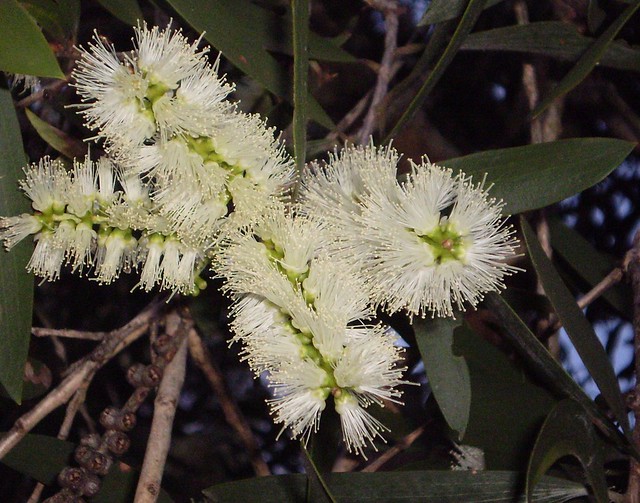
Below are pictures of melaleuca flowers, leaves and mature trees. 


For More information:


Gene Dempsey, City Forester
Environmental Services
Office - (954) 828-5785  Fax - (954) 828-4745

Think before you print!

Wednesday, December 12, 2012

Tips for Sustainable Giving

Okay, some of these are a repeat from yesterday’s thought but if you are like me, sometimes it takes hearing (or reading) it a few times before it really sinks in.

Tips for Sustainable Giving

Here are some ideas for giving without taking from the planet.

It's the thought that counts, and the personal touch makes any gift more meaningful and memorable. You can give more while spending less.


Services instead of Goods

Gifts of service require little or no use of natural resources, and are very personal and memorable. The gift of You - your time, energy or expertise are as 'giftworthy' as anything you can put in a box. Massage, music lessons, childcare, car wash, dogwalk, lawncare, tutoring, cooking, gardening, a book of coupons for household chores....

Experiences to enjoy and remember
Giving the gift of an experience can bring fun, learning and memories that hold value for years. For example, tickets to a show or concert can offer lasting value with minimal impact on resources. Sports events, local attractions, rock-climbing centers, ice-rink memberships, and museum memberships are other examples. Experiences can be other than 'entertainment' - for example, a membership to a car-sharing club in your city, or a garden plot in a local community garden.

Antiques and Collectibles

Value and appeal don't always have to mean 'new and shiny'. Antiques and collectibles have the added appeal of history and sentimental value.

Personal gifts tell a story. And because they're "re-used", there's no impact on the environment.

Found Objects

We all have our little treasures, our discoveries from nature. An unusual shell, crystal, wood burl, arrowhead, bone, shark tooth..... Over time we get used to seeing them and our interest wanes. Pass them on as a gift and they'll be "rediscovered" with enthusiasm, and impart their reminder of nature's wonder once again.

Edibles
Homemade is heartfelt. Your time and energy, and culinary creativity, are just as valued as that store-bought gift which they may not really even need. Your time spent in the kitchen is probably no more than the time spent gift-hunting online or at the mall. The result is most personal, and easy on the environment.

Flower Power

Gifts you can grow. Unique varieties can be raised in your small home plot, and make interesting, appealing gifts which anyone can use. Homegrown or store-bought, cut flowers or potted plants - the result is the same: eye catching, earth easy and rich with sentiment.
When buying flowers, choose from 'in season' locally grown varieties. The maintenance of greenhouses and long-distance transportation to provide summer flowers in winter can involve significant expenditures of energy, coming from fossil fuels.
(When buying potted plants, think of something that can be planted outside!)

"Used" Gifts
It's time to look at "used" in a new light.
Giving a used gift was once out of the question - it made the gift-giver feel cheap. And no one wants to risk offending the recipient. But used gifts are the kindest of all to the environment, as no energy or resources are expended.
There are some areas where used items can be appropriate as gifts, however, and the list grows with the steady accumulation of goods in our consumer society. Used computers, for example, can be refurbished and upgraded. Or consider vintage clothing, books and CD's, bikes, sports equipment, tools, cameras, children's toys and clothes. Used musical instruments are especially appropriate in this regard, as they often hold their value and appeal for a long time.
If you're still a bit uneasy with the concept, write a note on the gift card.
"We know how you love nature......this gift comes to you at no expense to the environment."

Think outside the box. Or use the box.
Not every gift has to be store-bought. A little imagination can go a long way. For example, a large cardboard box can be a lot of fun to a small child. The bigger the better. Give them markers and stickers to decorate their box creation; help them by cutting openings where they suggest.