Thursday, April 11, 2013

Tree Thursday - Champion Trees

Florida State Champion Trees

Every wonder what the largest tree in Florida is or the largest tree of a certain species.  The Florida Forest Service maintains a list of trees that have been registered as the largest of their species in Florida and in some cases, the second largest.  There’s even a list of native trees that don’t have State Champions.  You never know, you may have a State Champion tree in your backyard!  For information on nominating a tree go to Nominate.
Here’s some background on the program taken from the State website:

The Champion Tree Program was created by the American Forests organization in 1940, to recognize the largest known tree of each species in the United States. American Forests publishes their National Register of Big Trees every two years. The 2012 edition of the Register includes 111 Florida species, many of which are only found in the tropical region of the state. Florida now has the most national champions of any state. The largest National Champion tree in Florida is a native Shortleaf Fig, or Wild Banyan, located in Monroe County. This tree measures 444 inches in circumference, stands 48 feet tall, and carries a crown spread of 76 feet.
Florida began keeping a state register, the Florida Champion Tree Register, in 1975 to recognize the largest tree of each species within this state. It now contains hundreds of trees, including the national champions. All native and non-invasive naturalized tree species are eligible for nomination.
Although not a national champion, The Senator was the largest native tree of any kind in Florida until its demise in January, 2012. This gigantic baldcypress overlooked Big Tree Park in Seminole County from a height of 118 feet.  It measured 425 inches in circumference, and spread its crown over an average of 57 feet.

Search for a champion:
Note: Where the ownership type for a tree is listed as private, please obtain permission from the property owner, in advance, before visiting the location.
Can't find a particular species?
  • ·Listed invasive exotics are ineligible.
  • ·Non-native trees not recognized by American Forests can be certified as state champions.

A number of native Florida tree species currently do not have champions. We especially encourage people to nominate trees from this species list.

Get out and enjoy Florida’s natural resources and give special attention to the trees in honor of National Arbor Day that’s coming up on Friday, April 26.


Tuesday, April 9, 2013

Save A Tree, Plant a Tree - Paperless Utility Billing

Going paperless is a trend that is not going away.  I’m sure in a few years, the younger generation will look at us and wonder why we like to hold that paper bill in our hands and then file it away in a cabinet!  Many companies are starting to offer incentives to their customers to go paperless in billing and bill payment.  Going paperless has many advantages – it reduces costs, reduces paper waste and reduces carbon emissions by not having to be delivered through the postal system to name a few.  The City of Fort Lauderdale has recently rolled out “Save A Tree, Plant A Tree” to encourage its utility customers to go paperless by offering up to two free trees if they sign up for the program.  If your utility is not offering a paperless alternative, you need to encourage them to do so!

Save a Tree, Plant a Tree
Build a Canopy. Go Paper-Free!

The City of Fort Lauderdale presents Save a Tree, Plant a Tree, an innovative program that merges environmental protection and resource savings by offering free trees to Fort Lauderdale customers who switch to a paper-free utility billing process.
Save a Tree, Plant a Tree offers many benefits, including:
1. It promotes and encourages sustainability through paper-free services that save energy and natural resources.
The City of Fort Lauderdale prints approximately 54,000 utility bills each month, which equals 108 reams of paper. It takes 6 percent of one tree to make one ream of paper and one tree makes 16.67 reams of paper. If every City of Fort Lauderdale utility billing customer received an e-bill, he or she could help save approximately 6.5 trees per month or 78 trees per year1.
2. It increases the City’s tree canopy to cool, shade, and beautify homes, neighborhoods, paths, parks, and roads.
Twenty-one percent of the City of Fort Lauderdale is canopied by trees, and the City’s goal is to increase that to 25 percent by 2018. The tree canopy is vital to the health and beauty of the City, as it has many positive impacts. Trees provide shade, which helps reduce the heat island effect, a phenomenon of urban areas being warmer than surrounding rural areas due to the amount of concrete and asphalt being heated by the sun. Trees also help reduce stormwater runoff, filter pollutants, absorb carbon dioxide and provide oxygen, conserve household energy, save water, prevent soil erosion, and create a food source and safe home for native wildlife.
Trees also give a rural feel to urban areas, create recreational opportunities, and help increase property values. They also serve as landmarks that give neighborhoods a unique identity, as well as character and charm through their diverse shapes and sizes. Visually, trees help transform areas of brown, black and white into beautiful canopies of green.
3. It is a fiscally responsible alternative that helps “green” Fort Lauderdale while reducing expenses.
The City of Fort Lauderdale has 50,9862 utility customers and just 3,052 are signed up for e-billing. If the remaining utility billing customers only signed up for e-billing, the City of Fort Lauderdale would save approximately $183,499 per year, or $15,292 per month, on paper and postage needed to send out utility bills.

1. Calculations are based on a 40-foot tall tree that is six to eight inches in diameter.
2. Calculations are based on the number of utility customers as of 03/22/13.

GET A TREE BY GOING PAPER-FREE!
Getting a free tree is easy. Fort Lauderdale utility customers just need to sign up for Automatic Bill Payment and/or E-billing and then pick up their tree, or two trees if signed up for both services, on the prescheduled day set for the timeframe they signed up in. Three types of trees are available as part of the Save a Tree, Plant a Tree program, and they are native and Florida-friendly. This means the trees are adapted to Florida’s climate, are not invasive, and require minimal water, chemicals, and fertilizers.

For more information on this program go to http://www.fortlauderdale.gov/saveatree/index.htm .

Monday, April 8, 2013

Get Green in a Month - Week 2

By Natalie Cook
New York, NY, USA | Oct 2008

While a month doesn't seem like much time to tackle a major project, read how you can go green by just making one simple change each day. Here are your tips for week two of your eco-transformation.
8. Donate it. Instead of throwing away old clothes, electronics or house wares, donate them to a local charity organization. Remember to ask for a receipt so you can count the deduction when you file your income taxes.
9. Repair it. If you have a pair of pants that are in need of tender loving care, try repairing them before getting rid of them. Most dry cleaners have tailors on site to let you know how much it will cost to make your pants look new.
10. Share it. If you prepare more food than you can consume, feel free to share it with friends and neighbors. Sharing meals keeps great food in tummies and out of trash cans.
11. Switch it. When your incandescent bulb burns out, replace it with an energy-efficient florescent or LED light bulb.
12. Research it. Before purchasing big ticket items, research the how the product manufacturers are making environmental considerations. A quick on-line search can help you make the greenest purchase.
13. Collect it. Set a large container outside to collect rain water. This water can be used to hydrate your family's plants or pets. (Make sure you treat it to keep away mosquitoes.)
14. Return it. Buying biodegradable items means when you must throw something away, it will easily decompose. The decomposition process returns materials back to the earth.


Friday, April 5, 2013

Drink with a reusable straw

(Okay – I’m tired this morning and accidently sent out a Green Thought I was working on for next week so you get a bonus this Friday!)

One think I stopped doing a few years ago was using straws and the disposable lids on my drinks.  So far I haven’t had a major spill and I’m hoping this not only helps the environment (reducing waste) but I won’t have the wrinkly lips when I get old! J

Why This Matters
A lowly plastic straw may not seem like an environmental menace but consider this for example: 500 million straws are used in the United States every day. That’s enough to fill 127 school buses daily and 46,400 buses a year, and it means the average American will use around 38,000 straws between the ages of five and 65.
These straws end up as waste shortly after we plunge them into our drinks. Most of them become the worst kind of trash there is: lightweight bits of plastic that are easily windblown, able to float, and frequently end up loose littering the environment where they choke wildlife and threaten marine species. A recent Plymouth University study of fish in the English Channel found that over one third had ingested plastic.
That literally sucks. If you like straws, the trick is to use more sustainable varieties.

How To
There are lots of reusable plastic-free options available for slurping smoothies. Straws made from stainless steel, shatterproof glass, and even bamboo are eco-friendly and dishwasher-safe. You'll also avoid the chemicals in plastic getting into your drink of choice. Sip on.

Some alternatives to plastic (I haven’t used or purchased any of these but just wanted to let you know products like these are available.  Always to your own homework before buying!):

Strawesome Reusable Glass Straws  Dress up your lemonade, smoothie, or mixed drink with an elegant--yet durable--glass straw from Strawesome. Handcrafted in the USA from borosilicate glass, Strawesome says they are non-toxic, dishwasher safe, and guaranteed against breakage, so you can use them over and over.

Onyx Stainless Steel Straw Hmm, a single-use, shoddy plastic straw versus a reusable, indestructible, dishwasher safe, sleek stainless steel straw? It really is no contest. And, frankly, icy drinks just taste better when sipped through stainless particularly when it comes with a built-in bend--now that's easy living! I couldn’t find a website for them but they are available through Amazon. 

If anyone knows of a local store that carries reusable straws, please let me know!  One thing I know I need to get better at is letting the the wait staff know I don’t use or need straws!


If you want to get serious about being straw-free check out want a 9 year-old started http://www.ecocycle.org/bestrawfree .


Friday Funny


Thursday, April 4, 2013

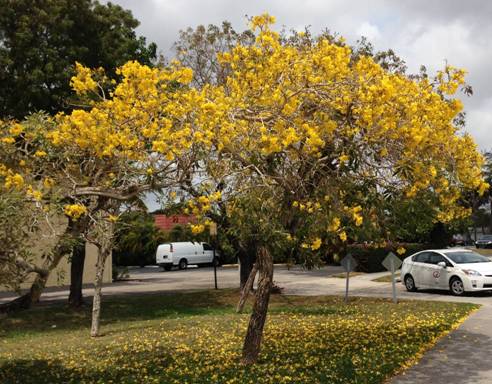
Tree Thursday - Yellow Tab

Silver Trumpet Tree or Yellow Tab
Tabebuia caraiba

This tree falls under the “what’s blooming now?” category.  Most of you in South Florida have probably notice this tree with the beautiful yellow flowers that has been blooming for the last few weeks. Commonly referred to as the Yellow Tab, at least by me, this tree gives a spectacular burst of color in the spring.  The “Silver Trumpet” common name refers to the silver color of the leaves and the trumpet shape of the flowers.  Most Tabebuias, and there are many – Gold, Purple, Pink, have “trumpet” in their common name because of the flower shapes.  The Yellow Tab was once planted prolifically around South Florida, it has fallen out of favor somewhat due to soft wood and the tendency to blow over.  This species was introduced to Broward County, Florida by the same woman, Annie Beck, which started the first Garden Club here. 

The Yellow Tab is an excellent tree for around utility lines due to the fact that it only gets to be 20 to 25 feet tall.  Avoiding specimens with circling roots at the time of planting can help the tree be more wind resistant.  This tree is originated from Paraguay, so it’s not native to South Florida but it hasn’t proven to be invasive. 

Growth Rate –                  Medium
Drought Tolerance –        High
Salt Tolerance –               Medium