Tuesday, August 12, 2014

Top 10 Green Tips For Children

Start them while they are young!  And parents – most of these will save you money, too!


By Joanne Capano on July 22, 2014
 
Teaching children to care for the environment is an important parental responsibility that is crucial for their future. But sometimes helping the planet can feel overwhelming for small shoulders. Remember to encourage young children to take one step at a time when going green. The little things they can do really make a big difference.

Many solutions to our environmental problems are very simple. There are many ways to care for the environment - from reusing common household items to putting paper and plastic in the recycle box. Encourage children to do one small thing, and then add another and another . Before you know it, those little steps add up to a lot more green. Also consider your children’s ages and how much responsibility they can handle. Above all, make it a fun family affair. Children learn best when they are happy and can model our behavior.
 
Here are 10 ways to encourage children to go green:
The power switch: One simple way we can conserve the earth’s resources is by not using more electricity than we need. Teach children to turn off lights when they leave a room and turn off the TV if they are not watching it.

Pull the plug:
Even when electronics and appliances are turned off, they still consume energy if plugged in the electrical outlet. Conserve energy by teaching older children to unplug their game systems, computers, chargers, or audio equipment. Little ones can participate too by becoming the family “plug police” and inform grownups of any unused household equipment that is plugged into an electrical outlet.

Tighten up:
Encourage children to check water taps in the house to make sure they are tightened and inform a grownup if any faucets leak. A drop-per-second leak wastes about 2,400 gallons of water a year.

Turn off the tap: Water should not be running while children brush their teeth. Teach children to turn off the tap and reduce shower time to conserve energy.

Collect rainwater: Water can be recycled too! Children often enjoy collecting rainwater. The next time it rains, place a pail or container outside and put a heavy rock or brick inside to prevent it from tipping over. When the rain is done, they will have a fresh supply of water to feed household plants.

Use community resources:
Libraries carry more than books. Selection of CDs, audio tapes and DVDs are also available. Some communities have toy lending libraries. Learn about community resources and encourage children to find items that are new to them instead of purchasing new things.
 
Pass it on: Clothes, toys and other household items that are no longer used can be donated to organizations instead of thrown into the trash. Pick through items with your children and find a local organization that will benefit from your donation. Children feel good knowing they are helping their community.

Litter free lunch challenge: Packaging our children’s lunches can create a lot of waste. Most disposable items can be replaced by reusable ones. Involve your children in finding creative ways to pack a healthy lunch that leaves no trash behind. Try inexpensive stainless steel cutlery instead of plastic, cloth napkins rather than paper, or thermoses, reusable glass, and plastic containers instead of disposable plastic or paper.

Reuse or recycle:
Teaching children to place recyclable items in the recycle bin is an important way to help the environment. Finding creative ways to reuse household items is another. Make it a fun challenge for the entire family. Be creative and you’ll be surprised how easily an empty cereal box can be transformed into a letter holder, or how quickly an empty shoebox can turn into a storage container for photos and artwork. The possibilities are endless! You’ll be reducing waste and having a fun time with the children’s new ideas.
 
Bike or Walk: Going somewhere doesn’t always mean having to use a car. Encourage your children to walk or ride their bikes for short trips. For younger children, grab your running shoes and walk or bike with them. In addition to reducing pollution, the entire family will benefit from some exercise.

Fostering a love for planet Earth, and teaching children the behavior needed to preserve its beauty, can be achieved when simple solutions are implemented. Fortunately, children are often eager and enthusiastic to lend a helping hand. With guidance, children will grow up to become stewards of the environment so their world will be a cleaner and safer place to live in.


Monday, August 11, 2014

To fight unemployment, India to plant 2 billion trees

Maybe we could/should do something like this in the U.S.!
 
A new initiative in India will employ up to 300,000 youths in an effort to improve air quality and provide opportunities to the unemployed.
Mon, Jul 21, 2014
 
What better way to clean the air along India's roadways than with trees? (Photo: seeveeaar/flickr)
 
Jadav "Molai" Payeng, the Indian man who single-handedly planted up 1,360 acres of forest, may soon have some competition on his hands. Or allies, depending on which way you want to look at it. Huffington Post reports that a new afforestation initiative from India's Rural Development Ministry aims to plant 2 billion trees along the nation's 62,137 miles of highways. The idea, says the article, is to both combat rural poverty and youth unemployment while also improving the environment and helping to clean up India's chronic air pollution:
 
“The country's Rural Development Ministry on Friday announced a new afforestation plan to plant 2 billion trees along the nation’s highways in an effort to tackle youth unemployment. The country’s Road Transport, Highways, Shipping and Rural Development Minister Nitin Jairam Gadkari said in a meeting in New Delhi that the new initiative would also help preserve the environment.
This plan cannot come soon enough. Not only does India have a youth unemployment rate of 10.2 percent, according to the World Health Organization, it is also home to six of the world's 10 cities with the worst air pollution. Given the deadly impact of air pollution worldwide, and the incredible power of trees to absorb emissions, this plan may have a significant impact not just on the economy and biodiversity, but on health as well.” 
 
The plan could potentially employ 300,000 youths, Indian outlet NDTV reports.  This isn't the only recent sign of environmental progress in India either. The country's new prime minister, Narendra Modi, has also announced a target of getting electricity to every home in India by 2019, relying largely on solar power to do so. According to The Hindu, the government is also working on plans to clean up the Ganga and Yamuna rivers. 


Friday, August 8, 2014

Seattle's First Urban Food Forest Will Be Open To Foragers

 
Below is an article about Seattle’s first urban food forest that was written over 2 years ago.  In checking their website – Beacon Food Forest – it appears Phase 1, a 2 acre site, will open on September 13, 2014.  I know these community projects take a long time and a lot of hard work to come to fruition.  Hopefully we’ll start seeing more of these pop up in other urban areas.  Happy Friday!  -Gene
 
From the Beacon Food Forest website -   “The goal of the Beacon Food Forest is to design, plant and grow an edible urban forest garden that inspires our community to gather together, grow our own food and rehabilitate our local ecosystem.”  “A food forest is a gardening technique or land management system, which mimics a woodland ecosystem by substituting edible trees, shrubs, perennials and annuals. Fruit and nut trees make up the upper level, while berry shrubs, edible perennials and annuals make up the lower levels. The Beacon Food Forest will combine aspects of native habitat rehabilitation with edible forest gardening.”
 
 
by Kristofor Husted
March 01, 2012
 
 
If you're a regular reader of The Salt, you've probably noticed our interest in foraging. From San Francisco to Maryland, we've met wild food experts, nature guides and chefs passionate about picking foods growing in their backyards.
Now, Washington state has jumped on the foraging bandwagon with plans to develop a 7-acre public plot into a food forest. The kicker? The lot sits smack in the middle of Seattle.
The idea is to give members of the working-class neighborhood of Beacon Hill the chance to pick plants scattered throughout the park – dubbed the Beacon Food Forest. It will feature fruit-bearing perennials — apples, pears, plums, grapes, blueberries, raspberries and more.
Herlihy and a team first assembled their vision of a food forest in 2009 as a final project for a permaculture design class.
 
If all goes well in the food forest's 2-acre trial plot, the whole 7-acre park will look something like this
 
After some community outreach, local support came pouring in for the idea. Herlihy and the Friends of Beacon Food Forest community group received a $22,000 grant to hire a certified designer for the project.
A local utility, Seattle Public Utilities, offered up the 7-acre plot, which could make it the largest, urban food forest on public land in the U.S., Glenn Herlihy, a steering committee member for the project, tells The Salt.
The group is currently working with $100,000 in seed money to set up the first phase: a 1.75-acre test zone to be planted by the end of the year. After a few years, if that section is deemed successful by the city, the remaining acreage will be converted to food trees.
Of course, any "free" food source begs the question of what to do with overzealous pickers. No definitive answer on how to handle that predicament has been established yet, though. According to Herlihy, the only solutions right now are to produce an abundance of fruit so there's enough for everyone and to embed "thieves' gardens" with extra plants in the park for those people eager to take more than their share.
For now, getting the park on its feet and drawing neighbors to its bushy terrain ranks highest on the totem pole of goals, Herlihy says. He hopes that the park will become a congregating area for the diverse residents of the neighborhood. "There's Vietnamese, Chinese, Filipinos, and Africans in the area. The Beacon Food Forest is a place where all ages and ethnicities can meet."
Eventually, garden plots in the forest will be available to lease to gardeners for $10 a year. Also, Herlihy says they hope to educate community members on the benefits of permaculture.
"It's a food system being developed in a neighborhood that's looking for more self-reliance," he says. "It's getting people together by having a common denominator: soil."


Thursday, August 7, 2014

How To Make A Stand Cast Birdbath in Leaf Shape

I meant to send this out yesterday for Wildlife Wednesday.  Oh, well – just one day late!  J
 
 
If you’re looking on ways to improve your garden design, we have just the thing to achieve that. This interesting looking bird bath will attract not only birds but people alike. Make sure you impress every visitor to your garden from now on by making the DIY Sand Cast Birdbath in Leaf Shape. Like the name says it, this birdbath is made in the shape of a leaf, in order to blend in with the rest of a natural environment. And thus, the birds will feel safer to take a bath in your lovely piece of decoration.
 
 
Here is the list of necessary items for this DIY project:
Materials
• Large leaf ( rhubarb leaf)
• 1 bag of sand
• 2 bags of concrete
• Water
• Plastic wrap
• Tubular concrete form
• Paint or concrete dye (optional)
• Concrete sealer
Tools
• Bucket or mixing Tray for concrete
• Hoe for mixing
• Scrub brush
• Paintbrush
• Foam brush
• 2 containers for paint and sealer
Begin with pouring the sand over a paper-covered surface and lay your leaf on top of it. Make sure you made a mound of sand in the center so the resulting birdbath will be a proper basin filled with water. When your concrete is all mixed in the bucket, pour it over the leaf. Leave it to harden and then apply the paint and sealer. You could choose to place the birdbath at a certain height, in which case you must also make a tall foot out of concrete. Fill your DIY work it with water in the end and watch how your garden will enrich itself with some birds and a brand new ornament.
 
3


Monday, August 4, 2014

The Gift Of Graft: New York Artist's Tree To Grow 40 Kinds Of Fruit

Sam Van Aken's grafted fruit trees are still quite young, but this artist rendering shows what he expects the "Tree of 40 Fruit" to look like in springtime in a few years.
 
by NPR Staff
August 03, 2014
 
It sounds like something out of Dr. Seuss, but artist Sam Van Aken is developing a tree that blooms in pink, fuchsia, purple and red in the spring — and that is capable of bearing 40 different kinds of fruit.
No, it's not genetic engineering. Van Aken, an associate professor in Syracuse University's art department, used an age-old technique called grafting to attach branches from 40 different kinds of stone fruit onto a single tree. It's called the "Tree of 40 Fruit." Weekend Edition's Arun Rath spoke to Van Aken about the project, and what inspired it.
 
ii
Van Aken recently grafted these stone fruit onto his "Tree of 40 Fruit."
 
"I'm an artist. So the whole project really began with this idea of creating a tree that would blossom in these different colors and would bear this multitude of fruit," he says.
But he soon discovered that it was actually pretty hard to find so many distinct varieties of stone fruit in New York, he explains in his presentation at TEDx Manhattan. "I realized the extent to which we've created these massive monoculture." Most grocery stores and markets only stock a few varieties — and most of them are grown in California.
But then Van Aken came across the New York State Agricultural Experimentation Station. "It was the largest orchard of its kind in the Northeast, perhaps even east of the Rockies," he says.
The three-acre plot contained all sorts of varieties of stone fruit, he says. "And they all had these amazingly different tastes."
That's when he started to understand the history behind these fruits, he says. "Then [the project] really became about preserving some of these antique and heirloom varieties."
The state wanted to close the operation down due to a lack of funding, so Van Aken purchased it in 2008.
His 16 trees around the country are composed of mainly antique and native stone fruit varieties, including peaches, plums, apricots and nectarines. In his TEDx talk, Van Aken says he's worked with 250 varieties of stone fruit at this point.
"I'm working with cherries, I've had limited success with that," he says. "I also graft almonds to them, because the almond blossoms are just absolutely amazing."
The process of building up these trees has taken years and a lot of patience. Van Aken starts with what's called a stock plan. He then inserts small, budding branches from other trees at strategic points throughout the stock tree. He tapes these grafts in place and lets them heal and and bond with their new base over the winter months. If all goes well, the grafts will start to grow in the spring.
The technique has been around for thousands of years, Van Aken says. "It appears on hieroglyphs in Egypt."
These days many commercial fruit trees are grafted — growers choose base trees that work well in their climate. And, Van Aken says, "nurseries now what they'll do is they'll sell combination trees, which are two varieties that will cross-pollinate each other, so you'll get a better fruit set."
As we've reported, a group of dedicated fruit fans in San Francisco are even using the technique to get the barren trees along city sidewalks to bear cherries, pears and apples.
Van Aken's trees are still quite young — his rendering shows what he expects them to look like in a few years. For now, he says, he's battling the squirrels, chipmunks, deer and groundhog that are threatening his labors of love.
"I get very Caddyshack," he says, laughing. "I'm a lot like Bill Murray during the summer."
 
You can go to the site below and hear the story:


Friday, July 25, 2014

Trees, Water and Sustainability

 
Loch Katrine— nestled on The Trossachs National Park in Scotland— depends on surrounding trees for Glasgow’s clean water supply.
 
When we think of forests, we think of trees, the wonders of nature, of sheer beauty, and clean, fresh air. We often don’t think about the water we drink.
We should.
More than 180 million Americans, 56 percent of the U.S. population, have abundant, healthy drinking water thanks to forests.
Forests help snow melt and rain water soak into the soil to replenish rivers and streams during dry times. Trees stop silt from eroding into our waterways. They serve as natural filters to clean sparkling mountain streams, healthy lakes and reservoirs, and our nation’s vast web of rivers.
Why is that important to us? As U.S. Department of Agriculture Secretary Tom Vilsack said, “While most Americans live in urban areas, most of us depend on rural lands, particularly forest lands, for clean water and a healthy climate.”
One example is New York City. In the late 1990s, city leaders balked at a $6 billion water treatment system and instead opted for natural forest management to clean the water it receives from the Catskill/Delaware watershed in upstate New York. The focus is on creating conservation easements along streams and reservoirs, and protecting forest lands to keep sediment and runoff from entering the water supply. The watershed provides New Yorkers with more than 1 billion gallons each day of some of the cleanest, healthiest drinking water in the world.
Millions of Californians rely on crystal-clear water flowing from the San Bernardino National Forest and other California forests to quench their thirst.
In Colorado, the South Platte watershed, which rises high in the Pike National Forest, supplies Denver with drinking water.
In Scotland, trees in The Trossachs National Park protect nearby Loch Katrine, which provides Glasgow its water supply. These are just a few examples of how our dependence on clean water also depends on healthy forests.
One way of keeping our forests healthy is to plant trees.
 
Klamath National Forest-California – After a fire, tree-planting crews are often in a race against time to plant new native trees.
 
The need to replant our forests is vitally important because of damage from insects, disease and unprecedented wildfires. Every year, new areas in critical need of replanting are identified – places where fires burn so hot that the seeds of future forests are destroyed.While we don’t know where the critical needs will be 10 years from now, or 40 years from now, we do know that our forests will continue to need our help, and that trees will be planted wherever they will best serve people, our environment, and water resources for generations to come.
There is no substitute for clean water. Water is a vital resource that we rely on every day. We can’t create something else to take its place.
But we can plant trees.
The next time you turn on the tap, remember the role trees play in keeping our drinking water clean and safe. And when we next think of forests, we’ll think of majestic beauty, clean air, habitat for wildlife…and healthy, abundant water for this and future generations.


Thursday, July 24, 2014

Replanting for Madagascar’s Future

How people and wildlife will benefit, and some of the world's great forests maintained for future generations.
 
Lemurs are little mammals found only in the forests of the island nation of Madagascar – and they are incredibly easy to love! What is less obvious is their close relationship with the future of trees in a land where, sadly, forests have often been leveled for short-term, gains. The lemurs are the victims. So are Madagascars impoverished citizens.
 
Black and White Ruffed lemurs provide an ecological service by aiding fruit seed germination through digestion of seed coatings. Photo by Dr. Edward Louis
 
Dr. Edward E. Louis Jr. of the Omaha Henry Doorly Zoo and Aquarium explains that 90 percent of a lemur's diet is fruit. Because of their enormous appetites, lemurs eat frequently and process their meals rapidly. Amazingly, this leaves behind seeds that have had their coatings removed through partial digestion but are otherwise intact. Dr. Louis has found that this produces seeds with a germination rate of nearly 100 percent, compared to only 5 percent of unprocessed seeds.
Thanks to the generosity of Arbor Day Foundation members, Rain Forest Rescue donations are being used to help residents and students collect these seeds for planting in nurseries that are being built in critical locations. It is all part of a plan devised by Dr. Louis and his colleagues to help restore the forests of Madagascar, provide habitat to save the endangered lemurs, and improve the economy and living conditions of local people.
We are creating a program that is sustainable, says Dr. Louis, head of the Madagascar Biodiversity Partnership (MBP). It is providing jobs today and for the childrens' future. It will also help Madagascar be less dependent on other countries, he says.
 
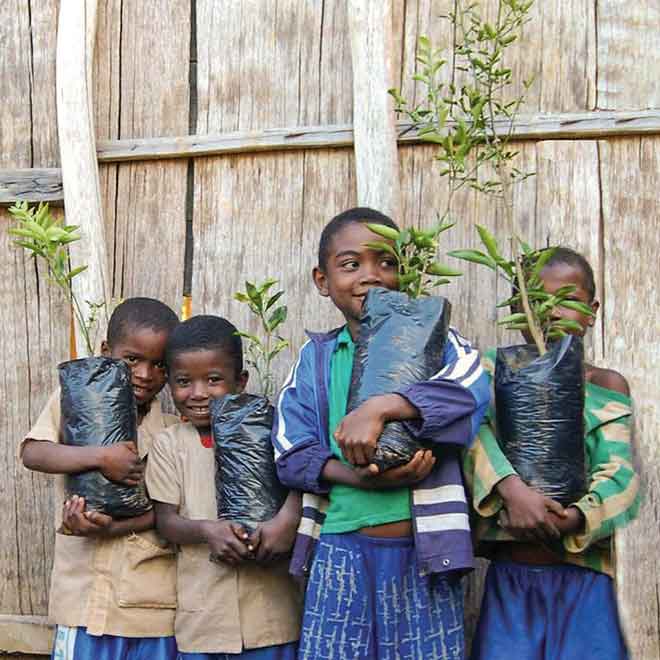
Area schools work with the Madagascar Biodiversity Partnership to teach children about conservation.
 
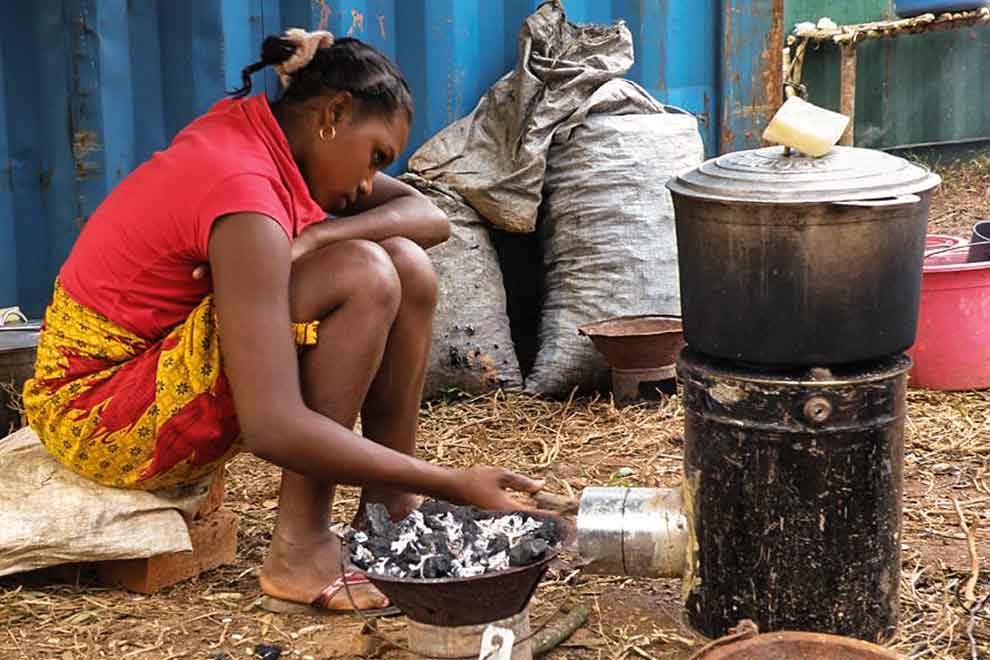
The low-cost, high-germination seeds are keys to the plan. So is what Dr. Louis calls the country's greenhouse-like climate. By building nurseries, people are employed and seedlings can be ready for planting quickly and economically. Through reforestation, erodible, denuded soil can be stabilized thanks to the growth rates of planted trees that sometimes measure ten linear feet a year or more. To encourage residents to engage in this better approach to their natural resources, incentives in the form of conservation credits are offered. These can then be exchanged for life-changing items such as fuel- saving Rocket Stoves and Tough Stuff Solar Kits.
Areas to be planted are prioritized to provide corridors between existing blocks of remaining forests. This is to allow movement of animals and assure genetic interchange that is essential to providing healthy populations and ending the sad history of extinctions that has plagued the country. Another strategy is to stratify the planting areas. Dr. Louis explains that typically the top 50 percent of a mountain will be zoned for permanent trees. These help serve as a water reservoir to feed the streams that are vital to the nation's rice fields. The next lower 35 percent of the mountain is planted with desirable timber species and managed for sustainable forestry. Rosewood, ebony and other valuable hardwoods are planted here for later selective harvest. Prompt replanting is part of the system to assure the continuous availability of forest crops without destroying wildlife habitat. The lower 15 percent is then devoted to fruit trees. Mangos, bananas, the popular litchi and others are planted for consumption or sale, as well as for sharing with lemurs.
 
Fuel-saving Rocket Stoves are one of the items provided to residents through the exchange of conservation credits.
 
While there is no simple solution to poverty and habitat destruction in Madagascar, the Biodiversity Partnership's innovative plan offers a practical way to encourage communities to sustain themselves through the conservation of resources rather than resorting to short-term exploitation. Rain Forest Rescue is a supporting partner in this promising endeavor. Through member donations, Madagascar's people and wildlife will benefit, ecotourism can be attracted, and some of the world's great forests will be maintained for future generations.
 
One way you can help save Rain Forests is through the National Arbor Day Foundation's Rain Forest Rescue Program.