Wednesday, September 10, 2014

How to build your own portable wildlife habitat! It's easy!

Check out the new video (starring yours truly) on the City of Fort Lauderdale’s website on How to Build a Balcony-Size Certifiable Wildlife Habitat.  Even if you live in a condo and only have a balcony (as long as it’s not screened in), you can create a wildlife habitat and become certified by the National Wildlife Federation.  It’s easy to build and only costs about $75 or less to create. 


Helping Backyard Birds Beat the Heat

Equipped with adaptations for keeping cool, birds still can use some help from humans during the long, hot summer
07-28-2014 // Melissa Mayntz
 
 
SUMMER IS A HOT SEASON, not just for bird-watching but for birds themselves, and the heat can take a toll on the animals. Just like birders who venture into the field without adequate water during summer, birds can suffer from heatstroke and overexertion—but bird lovers who provide cool, refreshing sanctuaries in their yards will be able to chill out with their feathered friends all season long.
From tanagers to buntings to hummingbirds, birds have evolved many physiological adaptations to keep cool. While birds do not sweat, bare skin on their faces and legs radiates body heat, and a higher respiration rate supports efficient panting. Many species can even control blood flow to their bills, which facilitates heat loss on hot days.
Behavior also helps birds beat the heat. Soaring high in cooler air can provide relief, while wing flutters or lifting feathers increases air circulation to keep skin cool. Many birds seek out shaded roosts on hot afternoons, doing most of their foraging during mornings and evenings. Some birds also use evaporative cooling: bathing or urinating on their legs, then allowing the liquid to evaporate and take away body heat.
As temperatures climb, however, birds’ physiological and behavioral adaptations may not be enough. Providing water and shade in your yard are easy and effective ways to attract as well as help out the animals.
Provide Plenty of Water
Water is the key to keeping backyard birds cool, but a basic birdbath is only the first step. Ideally, summer water features should include movement created by a dripper, mister or fountain because splashing sounds and glittering reflections attract birds. “The sound of moving water like a stream or even water slowly dripping into a basin or against a rock or foliage will attract many species of birds,” says Mark Kiser, Great Florida Birding and Wildlife Trail coordinator. “A mister device attached to a garden hose works wonderfully; the mister creates a fine spray that birds will either fly through to bathe in, or they will rub against the wet foliage.”
Moving water does more than bring in birds. Flowing and splashing slows bacterial and algal growth and discourages mosquitoes from breeding, minimizing the risk of mosquito-borne illnesses for birds and backyard birders alike.
When choosing a birdbath or other water feature, opt for one with different depths to accommodate both large and small species. A deep basin will discourage small birds from bathing, while a very shallow one will dry out quickly on hot days, particularly when birds bathe vigorously. “If the water is too deep, many songbirds and other small species won’t be able to use it,” Kiser says. “The right depth will depend on the size of the basin or container; one-half inch to one inch may suffice in many cases. Sloping sides allow birds of various sizes to access the depth they prefer.”
To keep a birdbath cool and full even in extreme heat, add a large chunk of ice to the bath each morning (freeze water in a plastic bowl the night before). As it melts, the ice will refill and refresh the bath. Proper hygiene is also essential. “Poorly maintained water features can spread disease, and pathogens thrive in summer heat,” says Sheri Williamson, co-director of the Southeastern Arizona Bird Observatory and author of the Peterson Field Guide to Hummingbirds of North America. Clean your baths at least once a week and more often if the water becomes discolored or contains algae or mold. Daily rinsing also will help keep a bath cleaner
Don't Forget Shade
As temperatures climb, shade is just as valuable to birds as water. To provide cool, shaded areas in your yard, create deeply tiered landscaping with broad-leafed native plants, adding vegetation around tree trunks or alongside buildings for even more shelter. “Native trees, shrubs and vines are particularly useful in the landscape to provide shade, shelter and food for birds,” Kiser says. “A dense, fruiting shrub, for example, can provide all three at the same time—protection from the heat and protection from predators as well as a food source.”
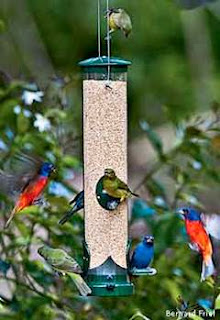
 
 
Place feeders in shaded areas during summer, which not only will help keep birds cooler but will keep oily seeds from spoiling as quickly. Similarly, bird houses should be mounted in shaded locations and have wide ventilation slits or holes under the eaves to provide cooling air circulation for nestlings. Place both houses and feeders in areas with gentle breezes for even more cooling, but keep them separate, as birds may be less comfortable in a house close to a busy feeding station.
Offer Reliable, Healthy Foods
No matter what the temperature, birds need to forage and stay alert for predators, and those activities generate a lot of body heat. Just as birders avoid strenuous hikes during the hottest part of the day, birds adjust their activity schedules during summer. You can help them by providing a healthy, reliable food source so the animals do not need to fly as far as frequently. “Birds that have a ready supply of healthy food can spend less time foraging and more time resting and bathing,” Williamson says. Good summer foods include sunflower seeds, fruit and nectar as well as no-melt suet. “High-quality food items will help keep birds healthy and their metabolism running smoothly so they are better equipped to deal with stressors such as periods of extreme temperature,” Kiser says.
To help hot birds rest safely, deter cats and other predators. Use baffles around bird feeders and houses, repair fencing and choose thorny landscaping that dissuades marauding predators. Birds that are safe will be less stressed by the heat and more comfortable visiting your feeders and baths.
For many of us, an ideal summer afternoon includes enjoying a refreshing drink on a cool, shaded patio. If you provide similar amenities in your yard, you won’t be disappointed by your feathered summer guests, even on the hottest days.

Welcome Wildlife
NWF’s Garden for Wildlife™ program provides gardeners with tips about native plants and other elements needed to create nurturing habitats for birds and other wildlife.
Become a NWF Wildlife Gardener. It's free and you will receive great gardening tips and learn how to certify your yard as a Certified Wildlife Habitat® site.

Melissa Mayntz is a Utah-based writer who covers wild birds and birding for About.com (birding.about.com). 


Monday, September 8, 2014

Get on board the non-consumption train

Ask yourself the following 13 questions before you continue through that check-out line.
Thu, Sep 09, 2010
 
 
I sat down at the keyboard this morning, all set to write up a new post when I found this note that I thought was worth sharing. I’ve had it on my computer for a while and, to be totally honest, have no idea where I found it, so I can’t really give credit where credit is due. My apologies to the original author but I assume that, given the nature in which it was written, they won’t mind me sharing it. As I recall, this was printed on a little card that the owner carried in his/her wallet. Every time they went to make a purchase, they were confronted with these questions — all of which spoke to the underlying wish: I want my money to support the environment, not destroy it.
 
1. Is this purchase something I need?
 
2. Do I already own something that will serve the same purpose?
 
3. Can I borrow one instead of buying new?
 
4. Can I make something that will serve the same purpose?
 
5. Can I buy a used one?
 
6. Would someone be willing to split the cost and share this with me?
 
7. Can I buy or commission one made locally?
 
8. Can I buy one that was made with environmentally responsible materials?
 
9. Can I buy one that serves more than one purpose?
 
10. Can I get something human powered instead of gas or electric?
 
11. Can I compost or recycle it when I’m done with it?
 
12. What is the impact on the environment of the full life cycle of it?
 
13. Does the manufacture or disposal of it damage the environment?
 
I love this because it’s simple, to the point, and a great “thought tree” if you will. I’m actually going to write it up on some used card stock and pop it in my wallet right now.
 
Many of you may feel that it’s a little ridiculous to have to carry something around like this, and indeed it may be. Sort of like having your mom looking over your shoulder shaking her finger at you for something you’re about to do.
 
But consider this: According to Consumer Reports, the average American is exposed to 247 commercial messages every day. If you do a little quick math, that comes out to 7,212,400 commercial messages over an 80-year lifespan. Crazy, isn’t it? Of course, if you don’t watch TV, you’ll cut a lot of those ads out, but even then you’re still bombarded.
 
Look in any magazine, newspaper, Internet site, or on any city street and you’ll see ads everywhere. On billboards, vehicles, T-shirts, and in some instances, even people (don’t try that at home). And what are all these ads telling us? That we will not be happy, healthy, wealthy, wise, popular, or anything else–unless we buy these products.
 
So what do we do? We buy. And every time we buy, we create demand, create waste, consume energy, and invariably, in the long run make ourselves less happy. Sure that iPhone rocks, but only until the new one comes out, and then you’ve got to jump on the train and consume again right?
 
So do I think that carrying around a little piece of paper is really going to change the world? Of course not. But I do believe that in order to start making things better, to clean up this whole waste/consumption mess, we all need to start thinking a little different. And in order to do that, we need to start asking ourselves some hard questions. Why do we feel that buying things will make us happy? What is fundamentally missing that we are trying to fill with mass produced product? Perhaps a little reminder like this will help us start that process and put us on the path to commercial freedom.
 
OK, riff over; I don’t want to do a redux of last week’s post. Write up the little list if you think it’ll help and run through those questions at the store the next time you are about to buy something non-essential. Before you know it, you’ll be steaming along on the non-consumption train and realize it’s really a much better place than you thought it was.
 
Live sustainably.


Wednesday, September 3, 2014

A Little Night Magic

 
After hearing a screech owl outside my house a week or so ago and a story on NPR about building a screech owl house, I thought I would provide some information to you about it.  I think I’m going to build one and see if I have any success on have some move in!   -Gene
 
 
Want to improve the after-hours scene in your neighborhood? Try hanging a screech owl box. 
By Kenn Kaufman
 
 
Night creatures go largely unseen, so people are often surprised to learn that they might have owls as neighbors. But it's true. Take screech owls, for example. Over much of this continent, from southern Canada south into Mexico, they can be common; in fact, studies have shown that screech owls can thrive in small towns, suburbs, even city parks.
 
Still, in America's tidy neighborhoods, as homeowners and townships trim away dead trees and large limbs and fill in natural cavities, good screech-owl nesting sites can be hard to find. Human-made nest boxes can make up for any shortage of natural nesting cavities, enabling these petite owls to live in places where they might otherwise be absent. This can help stabilize their populations.
 
There are two widespread species of screech owls, eastern and western, differing most obviously in voice. Neither actually screeches, except when agitated; most of their calls consist of mellow whistles and trills. Screech owls may spend their days sleeping in dense foliage or sitting next to tree trunks (where their mottled pattern provides camouflage), but more often they will be inside a cavity of some sort--a hollow limb, for instance, or a large woodpecker hole--hidden away from the sharp eyes of small songbirds, which will fuss about in a most irritating way when they find an owl sitting on its day roost. While a good cavity can help the owl avoid the annoying attentions of songbirds, it becomes essential during the nesting season.
 
Screech owl boxes have not inspired as much design experimentation as those for bluebirds or purple martins, but we do have some idea of what works. Fred Gehlbach of Baylor University, the world's leading authority on screech owl behavior, tried some variations on nest boxes as part of his studies on nesting habits. Gehlbach started by measuring natural cavities favored by the owls. He found the birds tended to use deeper cavities, more than 10 inches deep, with entrance holes not much larger than the minimum needed for their own entry. He also found that while the owls would use cavities with floors only six inches across, young owls were apt to fledge too early from such crowded nests. He had better success using boxes with floors that were eight inches square.
 
Although many experts recommend cleaning out nest boxes yearly, preferably in early spring, there's some disagreement on this point when it comes to screech owls. One reason for this is that the debris you'll find in screech owl boxes may have a life of its own.
 
Perhaps the oddest part of screech owls' behavior is their association with blind snakes, which have been found in the owls' nests. These odd snakes, which resemble large earthworms, normally appear only at night. Gehlbach and others have observed that the owls bring these small snakes to their nests and release them. The snakes feed on the larval and pupal stages of ants and flies that live in the nest debris, reducing the number of insects competing for the headless mice, dead beetles, and other tidbits cached by the owls. Gehlbach's studies suggest that the snakes actually contribute to the owls' breeding success.
 
It's important to place the box correctly. The natural cavities that screech owls choose are typically 12 to 20 feet above the ground and in deep shade. As the female incubates the eggs, the male is apt to spend the day roosting in dense foliage within about 20 feet of the nest. After you've placed an inch or so of dried leaves in the bottom of the nest, hang it at least 10 feet up on the trunk of a large tree. Try to place it away from sidewalks or doors, since the owls vigorously defend their nests against perceived threats. In fact, when the young are near fledging, some unusually spunky adults may swoop down at people or pets who wander too close, even raking them with their claws. So while placing the box in as secluded a spot as possible is good for the owls, it might be better for us, too.
Kenn Kaufman is the author of Birds of North America (Houghton Mifflin).
 
 
For plans on how to build a screech owl house, go to http://archive.audubonmagazine.org/backyard/backyard0201.html


Tuesday, September 2, 2014

The Most Natural Organic Pool You Can Build Yourself

JUNE 26, 2014 by APRIL McCARTHY
 
There are many reasons to avoid chlorinated pools, most of all due to your health and the environment. Natural Pools allow nature to provide hygienic water for swimming. The vibrant ecology of plants and animals condition the water so there is no need for any chemical disinfectants. These pools are healthy for people and wildlife. In fact the water quality in a natural pool is so good, many are well within drinking water standards.
 
 
Scientists have known for decades that along with the good that comes with disinfecting water with chlorine, chemicals called disinfection byproducts can also be formed when chlorine reacts with organic substances like human skin and residues from body care products.

Why is absorbing chlorine through the skin thought to be so dangerous? When you swallow water, you can count on the liver to filter out many toxins- but when something gets absorbed through your skin, it goes straight into the circulatory system.

Studies have shown that drinking, bathing or swimming in chlorinated water may increase the risk of bladder cancer. Chemicals, most commonly chlorine, used to disinfect water can produce by-products that have been tied to increased cancer risk.

Organic Pools
The nutrient level in an organic pool is carefully restricted so competition for the limiting nutrient (usually phosphorous) is fierce. In these circumstances, pond plants outperform algae, keeping it supressed and barely hanging in at the margins. A pond, low in nutrients, is a healthy environment for wildlife. An organic pool is teeming with life. If an alien micro-organism, a human pathogen for instance, enters the water, it faces battalions of hungry pond dwelling micro-organisms to either starve it out of existence, or devour it. A water analysis of this pond water showed that it contained zero organisms of e coli. per litre of water.

Swimming in a Natural pool among flowering plants of lilies, iris and marsh marigolds is a celebration of life. Soothing your limbs and mind and skin and eyes, it seems every cell in your body is telling you - this is the way swimming should be. Natural Pools work entirely with nature to provide hygienic water for swimming.
 
 
Natural pools use a fraction of the electrical energy used to maintain conventional pools. All of this is achieved without compromising healthy water. These pools have been designed to benefit wildlife - they are a nature reserve you can swim in!

The plunge pool is a proper organic pool (natural swimming pool), only smaller. And this one is small enough to fit in a modest garden to bring the delights of plunging into organic water to more of us.
 
 
Kids love this pool. They feel comfortable learning to swim in deep water knowing they can reach the shallows with a single kick of doggy paddle and an outstretched arm. It somehow manages to achieve being simultaneously cottage garden cozy and yet a sparkling wilderness.
 
Will the pool be full of Mosquitoes?
No. The water hosts a diverse ecology, which includes fauna that predates on mosquitoes. Mosquito larvae have nowhere to hide. Dragonfly larvae, Water Boatmen, Diving Beetle larvae eat the submerged mosquito larvae, while Pond Skaters and Whirligig beetles scoot over the water surface to devour emerging mosquito larvae from above. (Interestingly, a study of a bio-diverse, naturally occurring pond on a Caribbean island showed it contained no mosquito larvae.) Also, mosquito larvae prefer still water. Water in a Natural Pool is gently circulated.
 
What about human pathogens in the water?
The water holds a diverse ecosystem teeming with freshwater microorganisms constantly filtering the water for other microorganisms, including human pathogens, which have the misfortune to plop into the pool. Over the last 20 years, many thousands of these pools have been constructed in Germany, Austria, France, Switzerland, UK, Australia, USA. There have been no reported health issues with these pools.
 
What About The Pool Freezing In The Winter?
The pool design is fairly immune to freezing. There is no shallow pipework or wall to be vulnerable to ice. There is no problem with the pool freezing over. The local aquatic flora and fauna will be adapted to cope with the conditions.

What About Leaves Falling?
The pool can cope with some leaves in the pool, but if excessive they will rot down and add too many nutrients to the pool. A net can be strung over the pool in the autumn to catch the leaves.

Do-it-yourself Kits, Courses and Films available at www.organicpools.co.uk

April McCarthy is a community journalist playing an active role reporting and analyzing world events to advance our health and eco-friendly initiatives.


Friday, August 29, 2014

Friday Funny (or not so funny)

 
Are there things that you do in your office just because it's always been done that way?  Look for ways around the office to “green your routine” and bring it up to your manager.